Your logo is the first thing customers see on your shopfront, your delivery van, your invoice, your Instagram profile and the little icon in their WhatsApp chats. Most Kenyan businesses get it designed in a rush, for as little as possible, and then live with it for a decade. This is the complete guide to logo design in Kenya. It explains what a good logo actually does, how a professional logo design process works step by step, what you should receive at the end, what drives the cost, the mistakes and red flags to avoid, how to choose a designer, and a practical plan to get a logo that works as hard as you do.
Here’s the short version: a logo is not your brand. It’s the signature on your brand. If the business behind it is unclear, no logo will fix that. But when the strategy is right, a strong logo makes everything else you do easier to recognise, remember and trust.
What Logo Design in Kenya Is Really About
A logo is a visual mark that identifies your business. It can be a symbol, a word, initials, or a combination. Its job is simple to describe and hard to do well: be instantly recognisable, work everywhere your business appears, and signal the right things about who you are.
In Kenya, that “everywhere” is a long list. A good logo has to work on:
- a tiny WhatsApp Business or Instagram profile picture
- a website header and the browser tab icon
- signage that’s read from across a busy Nairobi street
- branded vehicles, uniforms, caps and branded mugs
- letterheads, invoices, receipts and KRA-compliant documents
- tender documents and company profiles
- embroidery, printing in one colour, and photocopies
- social media posts, video intros and event backdrops
A logo that looks beautiful on a laptop screen but turns into a blur on a profile picture, or costs a fortune to embroider, has failed at its job. Good logo design is as much about practicality as it is about looking good.
Logo vs Brand Identity vs Brand Strategy
These three get mixed up constantly, and the confusion leads businesses to pay for the wrong thing.
- Brand strategy is the thinking: who you serve, what you stand for, how you’re different, what you want people to feel and say about you.
- Brand identity is the full visual and verbal system that expresses that strategy: logo, colours, fonts, imagery style, icons, tone of voice and layouts.
- The logo is one part of that identity, usually the most visible.
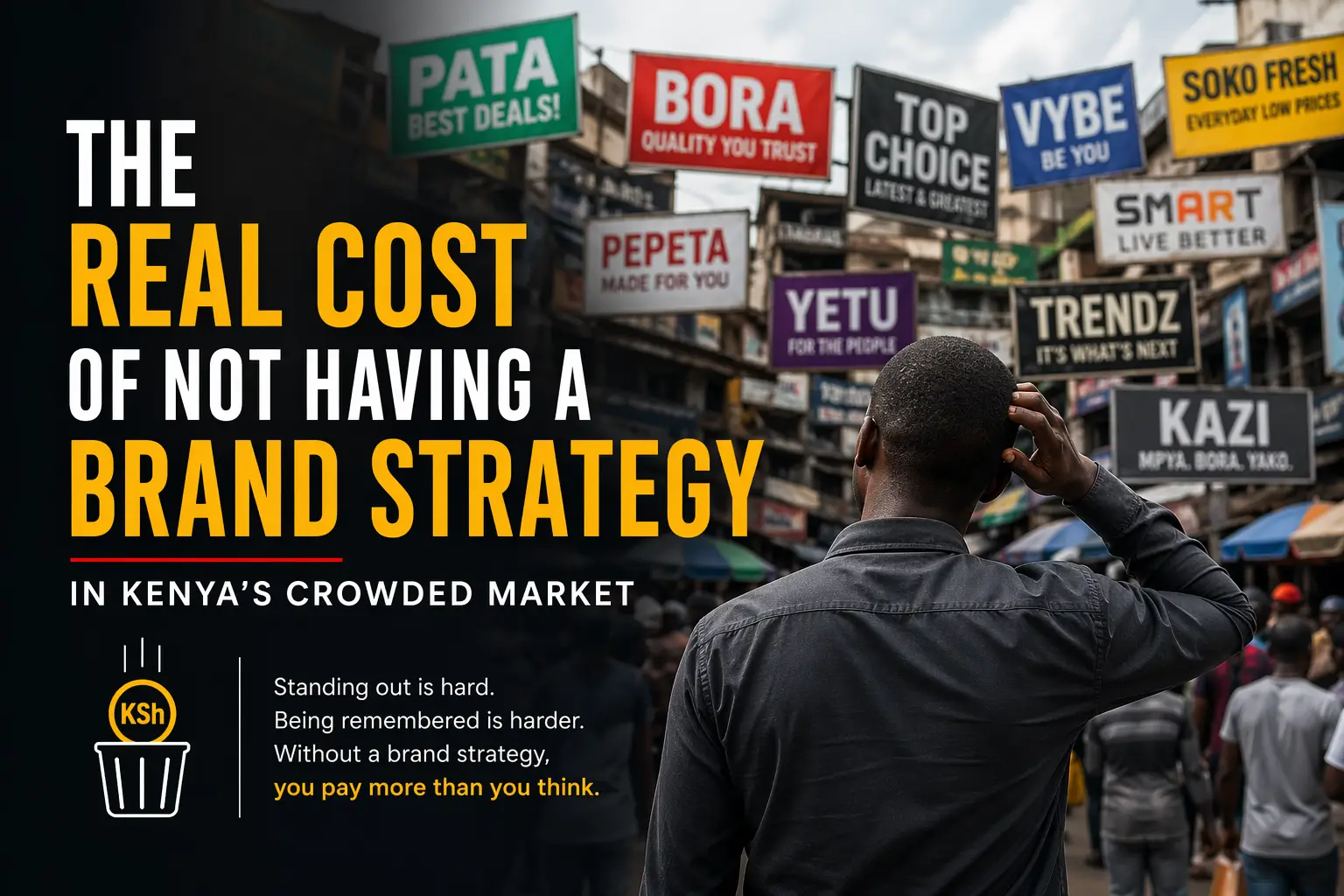
Buying a logo without a strategy is like printing a sign before you’ve decided what the shop sells. We covered why skipping the thinking costs Kenyan businesses so much in the real cost of not having a brand strategy in Kenya’s crowded market. This guide focuses on getting the logo itself right, but every step assumes you’ve at least answered the basic strategy questions.
The Main Types of Logos
Wordmarks
The business name set in a distinctive typeface. Great for short, memorable names. Simple to apply and easy for customers to read.
Lettermarks or monograms
Initials instead of the full name. Useful when the full name is long, but they only build recognition with consistent use over time.
Symbols or icons
A standalone graphic mark. Powerful once people know it, but a new business rarely gets recognised by a symbol alone, so it’s usually paired with the name.
Combination marks
A symbol plus the name. The most practical choice for most Kenyan SMEs, because the parts can be used together or separately: the full version on signage, the icon alone on a profile picture.
Emblems
The name inside a shape such as a badge or crest. Common for schools, clubs and institutions. They look strong but can be hard to shrink without losing detail.
A good designer will recommend a type based on your name, audience and where the logo will be used most, not just personal taste.
A note on colour
Colour does a lot of heavy lifting. It’s often the first thing people remember about a brand, long before the shape or the name. Pick colours that suit your sector and stand apart from your closest competitors, check that text stays readable against them, and make sure they print reliably. A colour that glows on a phone screen can turn muddy on a cheap printed flyer, so ask your designer to test both.
What Makes a Good Logo
Taste is subjective. Effectiveness isn’t. Judge any logo against these tests:
- Simple: can someone sketch it from memory after seeing it a few times?
- Distinctive: does it look different from competitors in your sector, or like every other logo with a swoosh, a globe or a lightbulb?
- Scalable: does it still read clearly as a tiny icon and on a large billboard?
- Versatile: does it work in full colour, one colour, black and white, and on dark and light backgrounds?
- Appropriate: does it suit your sector and audience? A law firm, a children’s school and a streetwear brand need very different feelings.
- Timeless: will it still look right in five or ten years, or is it chasing this year’s trend?
- Legible: can people actually read the name, including on a phone screen in bright sunlight?
How Professional Logo Design Works, Step by Step
A proper logo design process isn’t three random options sent on WhatsApp overnight. Here’s how a professional process runs.
- Discovery and brief. The designer learns about your business, customers, competitors, goals, values and where the logo will be used. A good brief is half the work.
- Research. Looking at competitors and the wider market to find what’s overused and where there’s space to stand out.
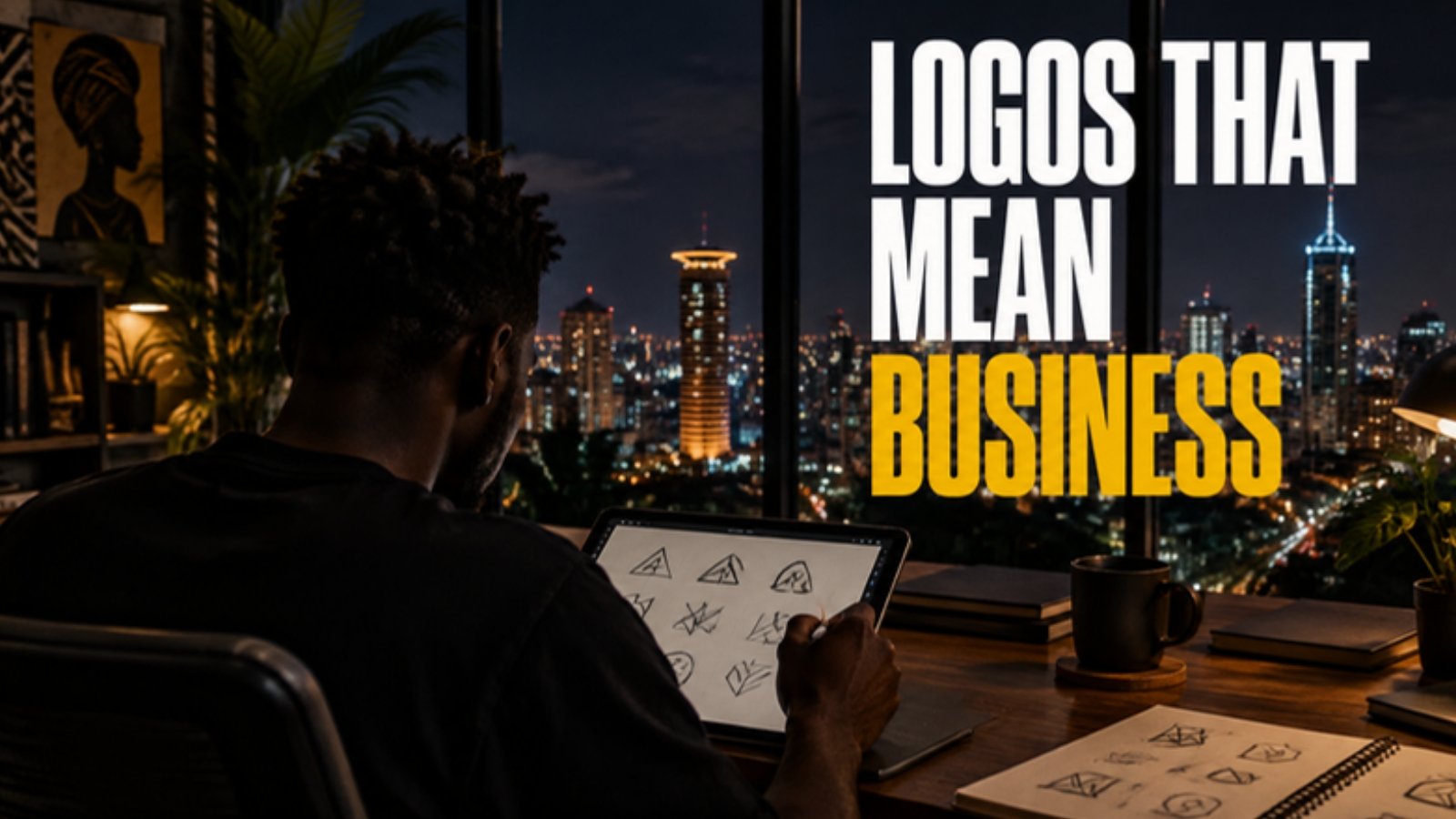
- Concept development. Sketching many rough ideas before choosing the strongest directions to develop digitally.
- Presentation. Showing a small number of well-developed concepts, each explained and shown in real situations such as signage, a profile picture, a uniform and a letterhead.
- Feedback and refinement. You choose a direction, and the designer refines it through an agreed number of revision rounds.
- Testing. Checking the chosen logo at small sizes, in one colour, on dark and light backgrounds, and in print.
- Finalisation. Producing every version and file format you’ll need.
- Guidelines and handover. Delivering a brand guide that explains how to use the logo, plus all the source files, with ownership clearly transferred to you.
Skipping steps 1, 2 and 6 is how businesses end up with logos that look like everyone else’s and fall apart on a printed T-shirt.
What You Should Receive: The Logo Deliverables Checklist
At the end of a logo design project in Kenya, you should hold all of the following. If you don’t, ask for them before you pay the final invoice.
- Primary logo in full colour
- Alternative layouts: horizontal, stacked and icon-only versions
- Colour variations: full colour, one colour, black, and white (reversed) for dark backgrounds
- Vector source files: AI, EPS, SVG or PDF, which can be scaled to any size without losing quality. Printers and signage makers will ask for these.
- Digital files: PNG with transparent background and JPG for everyday use
- A favicon and social profile versions sized for websites and social platforms
- Colour codes: HEX and RGB for screens, CMYK for print, and ideally Pantone references
- Typefaces: the names of the fonts used, and confirmation they’re licensed for commercial use
- A brand guidelines document covering clear space, minimum sizes, correct and incorrect use, colours and fonts
- Written confirmation of ownership so the rights to the final logo belong to your business
The last point matters more than most people realise. If a designer keeps the rights, or used stock elements you can’t own, you may have problems when you try to register a trademark or scale the brand.
What Drives the Cost of Logo Design in Kenya
Logo design prices in Kenya range from very cheap online gigs to substantial agency projects. Rather than chase a number, understand what you’re paying for. These factors drive the cost:
- Strategy and research: projects that include discovery workshops and competitor research cost more, and produce logos that are built on something.
- Number of concepts and revision rounds: more directions and more rounds mean more design time.
- Experience of the designer or agency: seasoned designers charge more because they get to the right answer faster and avoid costly mistakes.
- Scope of deliverables: a logo alone costs less than a logo with a full brand guide, stationery, social templates and signage designs.
- Complexity: custom lettering, illustration or a mascot takes more time than a clean wordmark.
- Usage and rights: full ownership transfer and original work, rather than templates, carry a fair premium.
- Timeline: rushed projects usually cost more and deliver less.
The real cost of a cheap logo
A very cheap logo often turns out to be a template, a lightly edited stock graphic, or a design that looks like a competitor’s. The cost shows up later: reprinting signage and uniforms when you rebrand, a trademark application that runs into trouble, or simply looking like a small, temporary business when you’re pitching for bigger contracts. Your logo will appear on thousands of items over the life of your business. Spread across that, investing properly is rarely the expensive option.
Common Logo Design Mistakes
Designing for yourself, not your customers
Your favourite colour or a symbol with personal meaning may mean nothing to the people you’re trying to win. Design for your audience.
Too much detail
Fine lines, gradients, shadows and lots of small elements look impressive on a big screen and vanish at small sizes. Most of the time your logo will be seen small.
Following trends
Whatever is fashionable this year will date quickly. A logo should outlast several marketing campaigns.
Copying a competitor or a big brand
Looking “like” a market leader makes you forgettable at best and invites legal trouble at worst.
Using too many fonts and colours
One or two typefaces and a tight palette are easier to apply consistently and easier to recognise.
Not checking the name and mark
Before you commit, search to see whether a similar name or mark is already in use in your sector. If you plan to protect your logo, trademarks in Kenya are handled by the Kenya Industrial Property Institute (KIPI), and it’s worth taking proper advice on registration.
Forgetting the website and digital use
Your logo has to work in a website header, as a favicon and on social media. A designer who only thinks about print will leave you with problems online. Our guide to web design in Kenya explains how the logo, colours and fonts carry into a website that converts.
Red Flags When Hiring a Logo Designer
- No questions asked. If a designer starts drawing before understanding your business, the result will be generic.
- Dozens of concepts for almost nothing. Volume usually means templates.
- No portfolio, or a portfolio that all looks the same.
- Refusal to hand over vector or source files.
- No clarity on ownership. Get it in writing.
- Unlimited revisions promised. It sounds generous but often signals a lack of process.
- Designs you’ve seen elsewhere. Do a quick reverse image search on concepts you’re shown.
How to Choose a Logo Designer or Branding Agency in Kenya
- Decide what you actually need. A logo only, a full brand identity, or strategy plus identity. Be honest about where your business is.
- Look at portfolios for range. Good designers create different solutions for different clients rather than one house style.
- Ask about the process. Listen for discovery, research, concepts, testing and guidelines.
- Check what’s delivered. Compare against the deliverables checklist above.
- Confirm revisions, timeline and payment terms in writing.
- Confirm ownership of the final logo and source files.
- Think beyond the logo. Will they help apply it to your website, social media, signage and documents?
Questions to ask before you hire
- What will you need to know about my business before you start?
- How many concepts will I see, and how many revision rounds are included?
- Which files and versions will I receive?
- Will I own the final logo outright?
- Do you provide brand guidelines?
- Can you show me how the logo will look on signage, a profile picture and a uniform?
Logo Design Timeline: What to Expect
Every project is different, but a professional logo project for a Kenyan SME usually follows this rhythm:
- Week 1: discovery call or workshop, brief agreed, research begins.
- Week 2: concepts developed and presented with real-world mock-ups.
- Week 3: feedback, refinement and testing.
- Week 4: final files, brand guidelines and handover.
Simple wordmarks can move faster, and full brand identities with stationery and templates take longer. What matters is that the time goes into thinking and testing, not just back-and-forth.
Rolling Out a New Logo Without Confusing Customers
A new logo only works once it’s used consistently. Plan the rollout:
- Update digital first: website, favicon, Google Business Profile, social profiles, WhatsApp Business and email signatures.
- Update documents: invoices, quotes, letterheads, company profile and proposal templates.
- Replace physical items in order of visibility: signage, vehicles, uniforms, packaging and merchandise.
- Tell your customers. A short announcement on social media and to your email list explains the change and builds excitement.
- Retire old files. Remove the old logo from shared drives so nobody uses it by accident.
Your marketing team or agency should apply the new identity everywhere at once. Inconsistent branding confuses customers and wastes the investment. A good digital marketing agency in Kenya will build your new look into every post, ad and landing page from day one.
A Practical 30-Day Plan for Your Logo
- Days 1 to 5: answer the strategy questions. Who are your best customers? What three words should they use to describe you? Who are your main competitors and what do their logos look like?
- Days 6 to 8: audit everywhere your current logo appears and note what doesn’t work.
- Days 9 to 12: shortlist designers or agencies, review portfolios and ask the questions above.
- Days 13 to 26: run the design process: brief, concepts, feedback, refinement and testing.
- Days 27 to 30: collect every file and the guidelines, confirm ownership, and start the digital rollout.
Where Your Logo Meets Your Website, Hosting and Marketing
Your logo will live on your website, in your email signature and across every campaign. That means it connects to the rest of your digital foundation. A sharp new identity on a slow, insecure site sends mixed signals, which is why we encourage businesses to review their setup alongside a rebrand. Our complete guide to web hosting in Kenya explains how to make sure the platform behind your brand is fast and reliable. And if your website is already struggling to turn visitors into customers, read why most Kenyan business websites are losing you customers before you invest in a new look.
How Twelvecity Digital Approaches Logo Design
Our branding and creative design work starts with your business, not a template. We dig into your customers, competitors and goals, develop concepts that are built for Kenyan realities from WhatsApp profile pictures to roadside signage, test them properly and hand over every file you need, with full ownership. Then we help you apply your identity across your website, social media and marketing, so it works from the first day. You can see the kind of work we do in our portfolio.
Frequently Asked Questions
How long does logo design take in Kenya?
A professional logo project usually takes around two to four weeks, depending on the scope, the number of concepts and how quickly feedback is given. A full brand identity takes longer.
Should I get just a logo or a full brand identity?
A new or small business can start with a logo plus basic guidelines covering colours and fonts. As you grow, a full identity with templates, imagery style and tone of voice keeps everything consistent across more people and channels.
Do I own my logo once it’s designed?
You should, but only if your agreement says so. Make sure ownership of the final design and source files is transferred to your business in writing.
Can I register my logo as a trademark in Kenya?
Yes. Trademarks in Kenya are registered through the Kenya Industrial Property Institute (KIPI). An original logo, rather than one built from stock elements, makes that process far more straightforward. Take proper advice before you apply.
How do I know if my current logo needs a refresh?
If it’s hard to read at small sizes, looks dated next to competitors, doesn’t work in one colour, or no longer reflects what your business has become, it’s time to review it.
Make Your Mark Count
Your logo will be seen more often than almost anything else your business produces. Treat it like the asset it is: built on strategy, tested for every use, owned outright and applied consistently. Start with the 30-day plan above, and if you’d like a team that designs logos built for Kenyan businesses, talk to us.
Call or WhatsApp us on +254 717 806 693, email hello@twelvecitydigital.com, or start your logo design project with Twelvecity Digital.
Disrupt. Build. Dominate.