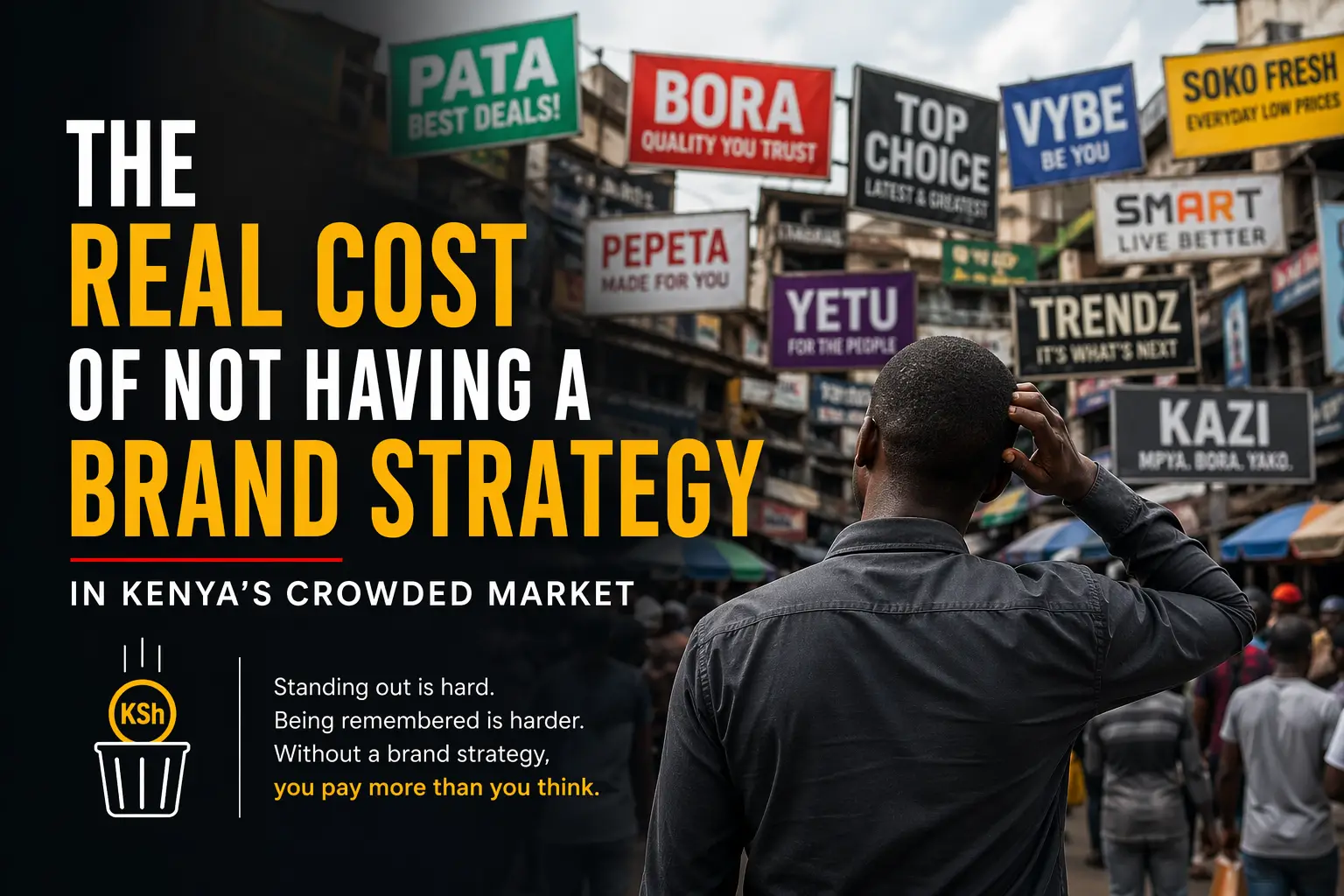
Here is a scenario playing out in hundreds of Kenyan businesses right now: two companies offering identical services, at similar prices, in the same city. One is growing. The other is struggling to find clients. The difference between them is not their product. It is not their pricing. It is not even their customer service.
It is their brand.
Brand strategy in Kenya is one of the most misunderstood and most underinvested areas of business in Kenya. Too many entrepreneurs and business owners treat branding as a cosmetic exercise — a logo here, a colour scheme there, maybe a new business card design. And then they wonder why their marketing isn’t working, why customers don’t remember them, and why they keep competing on price when they’d rather compete on value.
The truth is brutal and simple: in a crowded market, a business without a brand strategy is a business without a direction. And in Kenya’s rapidly evolving commercial landscape, that is a position you cannot afford to be in.
What Brand Strategy Actually Is — And What It Isn’t
Let’s clear something up immediately: a brand is not a logo. A brand is not a colour palette. A brand is not a tagline, though a great tagline can express one.
A brand is the total impression your business makes on the people who encounter it — what they feel, what they think, what they remember, and ultimately whether they choose you over someone else. Your brand is the answer to the question: ‘Why should I trust this business and not the one next door?’
Brand strategy is the deliberate, structured work of defining and communicating that answer — consistently, compellingly, and across every touchpoint your customers experience.
It includes your positioning: who you are for, and who you are not for. It includes your messaging: the specific language you use to describe your value in a way that resonates with your ideal customer. It includes your visual identity: not just a logo, but a complete visual language that signals professionalism, personality, and purpose. And it includes your brand experience: how every interaction — from a WhatsApp enquiry to an invoice to a post-delivery follow-up — reinforces or undermines the brand promise you’ve made.
When all of these elements are aligned and intentional, brand strategy becomes one of the most powerful commercial tools a business can have. When they are absent — or worse, inconsistent — they become a silent killer of growth.
Kenya’s Market Has Changed. Has Your Brand Kept Up?
Kenya’s business landscape has undergone a dramatic transformation in the past decade. The rise of mobile commerce, the explosion of social media as a discovery channel, and the growth of a confident, discerning middle class have fundamentally changed how Kenyan consumers make decisions.
According to a 2023 report by Ipsos Kenya, brand trust is now cited as one of the top three factors influencing purchase decisions among Kenyan consumers — ranking alongside price and product quality. This is a seismic shift. A decade ago, in many categories, price was king. Today, consumers are choosing brands they believe in, brands they identify with, and brands that communicate shared values.
The same report found that over 65% of Kenyan consumers research a business online before making contact — and that their perception of the brand is significantly shaped by the visual and messaging consistency they encounter across platforms. A business that looks one way on Instagram, another way on its website, and presents itself differently again in person is sending a signal of disorganisation that erodes trust before the conversation has even started.
Meanwhile, competition in virtually every sector — from financial services to food delivery to professional services — is intensifying. New entrants are emerging constantly. International brands are investing in the Kenyan market. And regional players from across East Africa are positioning themselves for national growth.
In this environment, a weak brand is not just a missed opportunity. It is a competitive disadvantage that compounds over time.
The Five Symptoms of a Business Without a Brand Strategy
Not every business knows it has a brand problem. Often, the symptoms present themselves as other issues entirely. Here are the most common warning signs:
You compete on price — constantly.
When you have no clear brand differentiation, price becomes the default argument. Customers have no compelling reason to choose you over a cheaper alternative because you haven’t given them one. Businesses without strong brand positioning are trapped in a race to the bottom on pricing — and it is a race nobody wins.
Your marketing produces inconsistent results.
You run a Facebook campaign one month, try Google Ads the next, do a flyer drop after that. Nothing seems to stick. The problem is rarely the channel — it’s the message. Without a brand strategy to anchor your marketing communication, your efforts are fragmented and forgettable. Effective marketing is built on the foundation of a clear brand.
Customers struggle to describe what you do or why you’re different.
If your customers can’t articulate your value proposition clearly, that is a brand messaging failure. Word-of-mouth — still one of the most powerful growth engines for Kenyan businesses — depends entirely on your existing customers being able to explain why they chose you. A confused customer is a silent one.
Your visual identity looks inconsistent or outdated.
Different logos on different documents. Colour inconsistencies across platforms. A website that doesn’t match your social media. A business card design that doesn’t align with your signage. Each of these inconsistencies chips away at perceived professionalism and credibility — often subconsciously, but always effectively.
You struggle to charge what you’re worth.
Premium pricing is a brand conversation. The businesses that command the highest prices in any sector — whether it’s a law firm in Upper Hill or a restaurant in Karen — do so because their brand communicates a level of quality, trust, and desirability that justifies the premium. Without that brand foundation, price resistance is constant and inevitable.
What a Brand Strategy Actually Costs — And What Not Having One Costs More
There is a persistent myth in Kenya’s SME community that professional branding is expensive and therefore optional. Let’s examine this belief honestly.
A professionally developed brand strategy — including positioning work, messaging framework, visual identity system, and brand guidelines — is an investment. For a small to medium-sized Kenyan business, that investment might range from KES 150,000 to KES 500,000 or more, depending on scope and the agency involved.
That sounds significant. But consider what you are paying for: a commercial foundation that will shape every marketing decision, every customer interaction, and every growth initiative your business undertakes for years to come. A brand, unlike a Facebook ad, does not expire. Its value compounds with every consistent expression of it.
Now consider the cost of not having it. Consider the revenue lost to competitors with stronger positioning. Consider the marketing budget spent on campaigns that don’t convert because the brand message is unclear. Consider the talent that chooses to work for a better-branded competitor. Consider the clients who chose the more professional-looking option, even though your service was equally good or better.
The real cost of not having a brand strategy is not a one-time figure. It is a monthly leak — of customers, of revenue, of market share — that most businesses never directly attribute to branding because the loss is slow and invisible.
Building a Brand That Works in the Kenyan Context
Brand strategy in Kenya requires cultural intelligence that generic, template-based approaches simply don’t deliver. The Kenyan consumer is sophisticated, diverse, and deeply aware of authenticity. A brand that feels imported, generic, or disconnected from local reality will struggle to build genuine loyalty.
The most powerful Kenyan brands — whether homegrown names like Safaricom, KCB, and Equity Bank, or local businesses that have built fierce community loyalty — share certain characteristics:
- They know exactly who they are for and speak to that audience with precision and consistency
- They communicate values that resonate with Kenyan realities — community, resilience, ambition, and trust
- They present themselves with visual confidence and consistency across every platform and touchpoint
- They have invested in understanding their customer’s world and reflecting it back authentically
- They treat their brand as a living asset, not a set-and-forget exercise
These principles apply whether you are a multinational or a neighbourhood business. The scale changes. The fundamentals do not.
A Special Word for Kenya’s NGOs and Social Enterprises
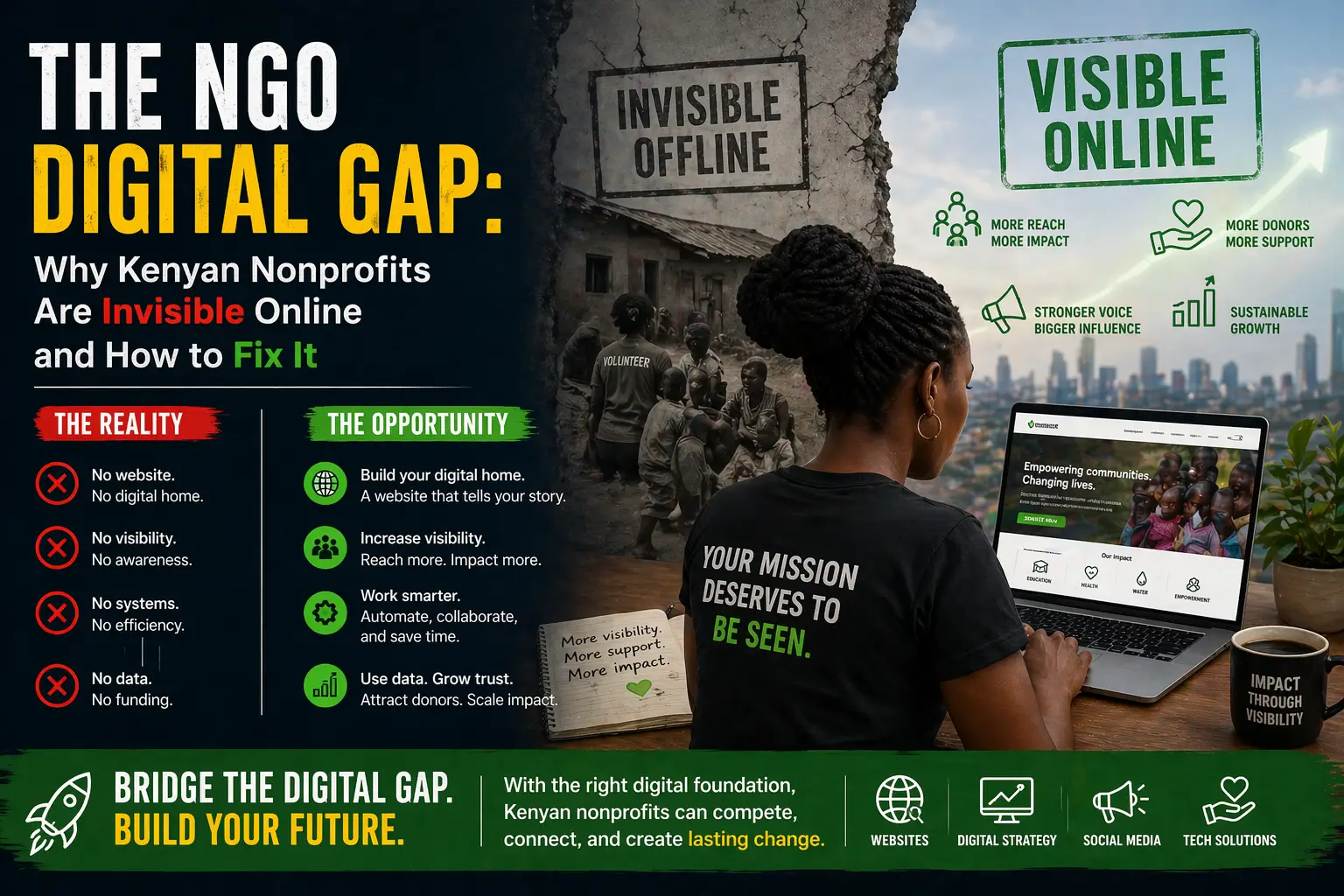
Brand strategy is not only a commercial imperative. For Kenya’s NGOs, charities, and social enterprises, a strong brand is the difference between an organisation that attracts funding, volunteers, and public support — and one that operates in permanent obscurity despite doing genuinely important work.
Donor organisations — whether international foundations, corporate CSR programmes, or individual philanthropists — make decisions partly based on the professionalism and credibility of the organisations they fund. A poorly branded NGO, no matter how impactful its work, is starting every funding conversation from a position of disadvantage.
The communities you serve also deserve a brand that communicates respect, competence, and commitment. How you present your organisation is a statement of your values — and an underdeveloped brand can unintentionally undermine the trust you’re trying to build.
The Twelvecity Perspective
At Twelvecity, we believe that every Kenyan business — regardless of size, sector, or budget — deserves a brand built with purpose and intelligence. We don’t do cookie-cutter logos or generic templates. We do strategy-led, culture-aware brand development that gives businesses a real commercial foundation.
We’ve worked with startups finding their voice, established businesses reinventing themselves, and social organisations trying to communicate their impact to a wider world. In every case, the starting point is the same: clarity. Clarity about who you are, who you serve, and why it matters.
Because in Kenya’s crowded, competitive, fast-moving market, clarity is the most powerful brand asset you can have.
Is your brand doing the work it should be doing? Talk to Twelvecity about a brand strategy consultation — and find out what your business could look like with a brand that means something.