There are thousands of organisations in Kenya doing extraordinary work. Feeding children in informal settlements. Equipping young women with skills to break cycles of poverty. Rehabilitating drug users. Conserving ecosystems. Advocating for the rights of people whom power has forgotten.
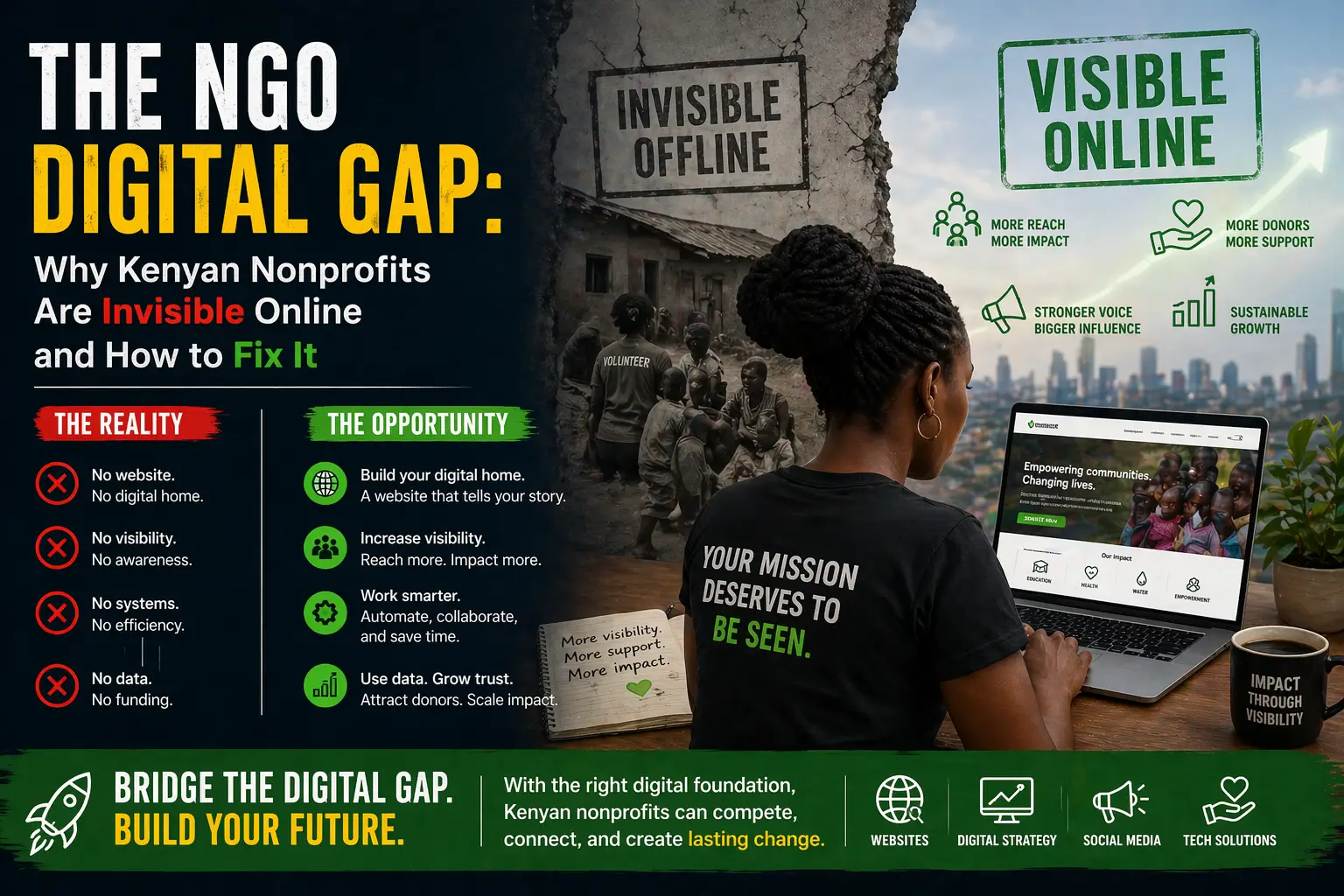
Most of them are invisible online.
Not because their work is unimportant. Not because their impact is minimal. But because they have not been told — or have not had the resources to act on the fact — that in 2026, an organisation without a credible digital presence is an organisation that the world cannot find, cannot trust, and cannot fund at the scale its work deserves.
This is the NGO digital gap. And it is costing Kenyan civil society more than most people realise.
The Stakes Are Higher Than They Appear
Let us be direct about what is at stake when a Kenyan NGO or charity has a weak digital presence.
First, there is funding. International donors — foundations, bilateral aid organisations, corporate CSR programmes, and individual philanthropists — have fundamentally changed how they discover and evaluate grant applicants and implementing partners. Before a formal application is even reviewed, programme officers are looking organisations up online. They are visiting websites. They are checking social media activity. They are searching for evidence of credibility, transparency, and impact.
According to the 2024 Nonprofit Technology Report by NTEN, over 80% of foundations and institutional donors conduct an online review of potential grantees as part of their due diligence process. An NGO with a non-functional website, an empty social media presence, or outdated programme information is starting every funding conversation with a credibility deficit.
Second, there is community trust. The communities that Kenyan NGOs serve — and their families, advocates, and local leaders — increasingly look for organisations online before engaging with them. A professional, informative digital presence communicates that an organisation is legitimate, accountable, and operating with the transparency that vulnerable communities deserve.
Third, there is talent. The next generation of Kenyan social sector professionals — the programme managers, M&E specialists, communications officers, and field coordinators who will carry the sector forward — are making employment decisions partly based on digital presence. An NGO that looks invisible or unprofessional online is less likely to attract the best candidates.
Why So Many Kenyan NGOs Are Digitally Invisible
The reasons are structural, not motivational. Kenyan NGO leaders are not indifferent to digital presence. They are, almost without exception, deeply committed to their missions and working under significant resource constraints. The digital gap exists because of several compounding factors:
Budget prioritisation.
In an environment where every shilling must be justified against programme outcomes, communications and digital infrastructure are frequently the last items on the budget — if they appear at all. Most donor funding is programme-specific and does not cover organisational development expenses like website design or digital strategy. This creates a structural underfunding of the very tools that would help organisations attract more diverse, flexible funding.
Skills gaps.
Many Kenyan NGOs do not have a dedicated communications or digital team member. Communications responsibilities are distributed among programme staff who are already overextended. The result is a social media account that goes quiet for months, a website that hasn’t been updated since the last project cycle, and a digital presence that doesn’t come close to reflecting the organisation’s actual impact.
The ‘good work speaks for itself’ fallacy.
There is a deeply held belief in some corners of Kenya’s civil society that doing good work is sufficient — that organisations shouldn’t need to ‘market’ themselves. This belief, however well-intentioned, is actively harmful. In a world where attention is finite and competition for funding is fierce, visibility is not vanity. It is a survival mechanism.
What a Credible NGO Digital Presence Actually Requires
The good news is that building a credible digital presence for a Kenyan NGO does not require a communications department or an enterprise budget. It requires intentionality, structure, and a willingness to treat digital presence as an organisational priority — not an afterthought.
At minimum, a Kenyan NGO in 2026 needs:
- A professional, mobile-optimised website that clearly communicates mission, programmes, impact, team, and how to get involved or donate
- An updated ‘Our Work’ or ‘Impact’ section with real data, real stories, and real evidence of outcomes — updated at least quarterly
- A consistent social media presence on at least one platform, with content that reflects current programme activities and organisational values
- A clear, easy-to-find donation or partnership pathway for individuals and organisations who want to contribute
- Downloadable resources — annual reports, programme summaries, policy briefs — that demonstrate professionalism and transparency to institutional audiences
- An organisational email address (not Gmail or Yahoo) that communicates professionalism in every correspondence
Beyond this baseline, organisations with the capacity to invest further should consider content marketing that documents their programme learning, SEO optimisation to appear in searches for their area of focus, and email communication strategies to maintain relationships with donors and partners between grant cycles.
The Funding Conversation Digital Presence Enables
Here is a concrete illustration of what is possible when a Kenyan NGO invests in digital presence.
An organisation working on girls’ education in Kenya’s arid and semi-arid lands builds a professional website with programme data, beneficiary stories (with appropriate consent), an annual report, and a clear theory of change. They are active on LinkedIn — the primary professional network for the international development community — sharing programme updates, learning, and thought leadership. Their Google Business Profile is complete and verified.
A programme officer at a European foundation searching for implementing partners for a new girls’ education initiative in East Africa finds them on page one of Google. The website communicates credibility instantly. The LinkedIn presence shows an active, reflective organisation. The annual report demonstrates financial accountability.
The organisation receives an unsolicited expression of interest. They had not applied. They were found.
This is not a fantasy. It is happening for the Kenyan NGOs that have made the investment. And it is not happening for those that haven’t.
Twelvecity’s Commitment to Kenya’s Social Sector
At Twelvecity, we have a specific and unwavering commitment to supporting Kenya’s NGOs, charities, and social enterprises. We believe that organisations doing the most important work in our society deserve digital infrastructure that matches the significance of that work.
We work with social sector organisations who have limited budgets and high impact ambitions — building websites, developing digital strategies, and creating communication frameworks that are practical, sustainable, and aligned with the realities of nonprofit resourcing.
We do not believe that doing good work and presenting it well are in tension. We believe they are inseparable. Because an organisation that cannot be found cannot help the people it exists to serve.
Is your NGO or charity invisible where it matters most? Talk to Twelvecity about a digital presence built for the social sector — professional, impactful, and within reach.