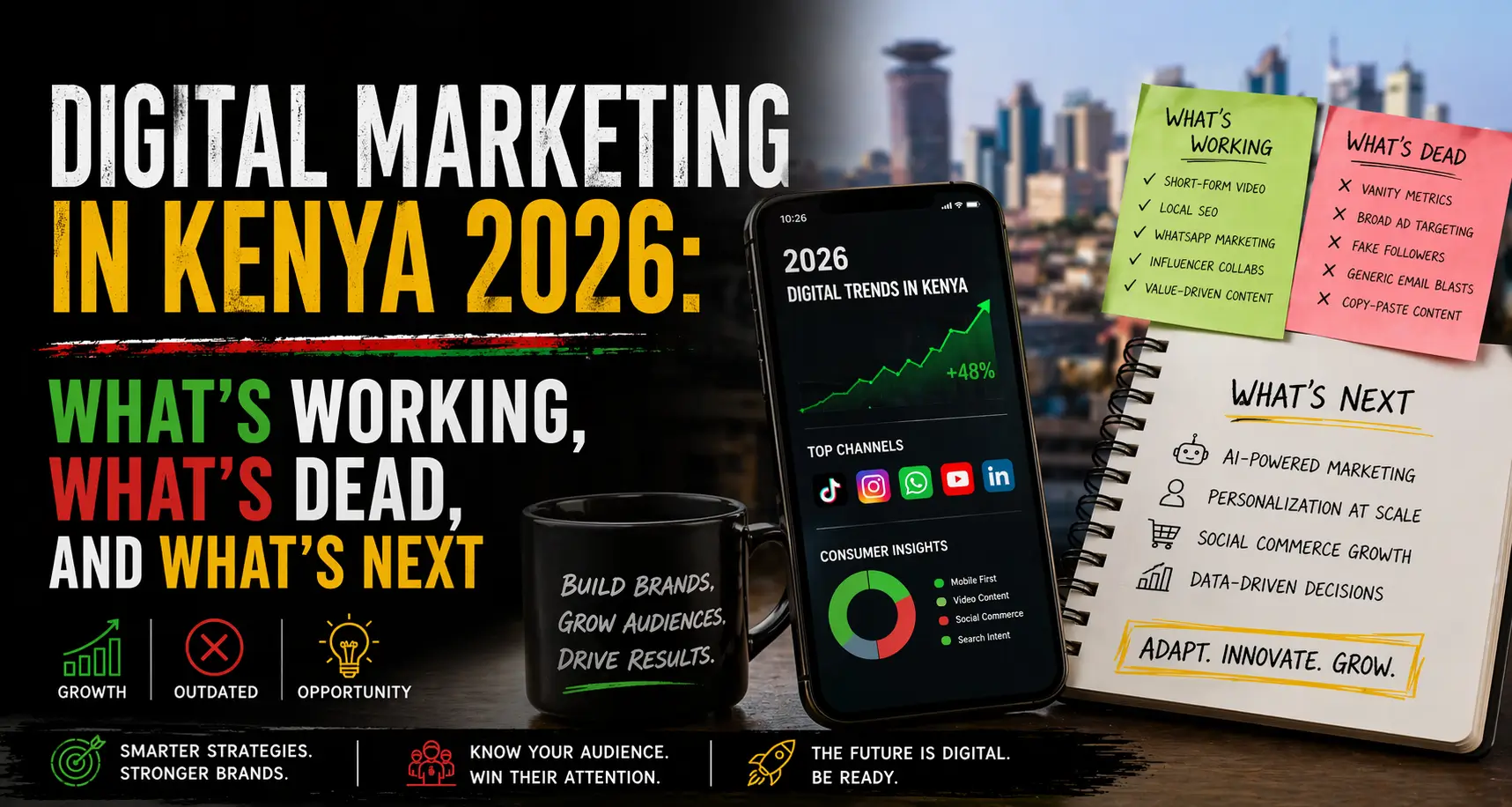
If you are still running your digital marketing in Kenya the same way you were running it in 2022, you are not behind the curve. You are off the map entirely. Because the state of digital marketing in Kenya today is not what thought it.
The Kenyan digital marketing landscape has shifted so dramatically in the past three years that strategies which once delivered reliable results are now producing diminishing returns — or nothing at all. Meanwhile, the businesses that have adapted are pulling away from those that haven’t, quietly capturing market share and building digital audiences that will compound in value for years.
This is not a theoretical concern. It is a present-tense commercial reality. And in this article, we are going to be completely direct about what is working, what is no longer working, and where the real digital marketing opportunity in Kenya lies in 2026.
The State Of Digital Marketing in Kenya Landscape in 2026: Setting the Scene
Kenya remains one of the most digitally dynamic markets in sub-Saharan Africa. The Communications Authority of Kenya’s 2025 annual report recorded over 46 million internet subscriptions, with mobile internet accounting for more than 97% of connections. Social media penetration continues to climb, with platforms including Facebook, TikTok, Instagram, YouTube, and X (formerly Twitter) all maintaining significant active user bases.
Perhaps most significantly, Kenyan consumers have grown more sophisticated. They are more sceptical of advertising, more discerning about the content they engage with, and more capable of distinguishing between brands that genuinely add value and those simply chasing clicks. The audience has matured. The question is whether Kenya’s marketers have matured with it.
The answer, frankly, is mixed. A handful of forward-thinking brands and agencies are doing genuinely excellent work. But a large proportion of Kenyan businesses — particularly SMEs — are still investing in digital marketing tactics that are delivering a fraction of their former returns, without understanding why.
What’s Dead: The Tactics That Have Stopped Working
Let’s start with the uncomfortable part.
Vanity-metric social media management
Posting generic content three times a week, celebrating follower counts, and measuring success by likes and shares is a marketing strategy that belongs in 2018. In 2026, organic reach on Facebook for business pages in Kenya has declined to levels that make it statistically irrelevant for most accounts without paid amplification. Instagram reach for non-video content has similarly collapsed. Posting for the sake of posting — without a clear content strategy, engagement mechanism, or conversion pathway — is burning time and money for nothing.
Spray-and-pray Google Ads campaigns
Running a broad Google Ads campaign targeting generic keywords — ‘marketing agency Kenya’, ‘accountant Nairobi’ — without robust audience targeting, negative keyword lists, landing page optimisation, and continuous bid management is one of the most efficient ways to waste a marketing budget available. We have audited Kenyan business Google Ads accounts where 60-70% of spend was going to irrelevant clicks. The money was leaving. The customers were not arriving.
Buying fake followers and engagement
This one should be self-evidently pointless, yet it persists. Inflated follower counts that don’t convert to customers, don’t engage authentically, and actively damage algorithmic performance are worse than useless. Platforms have become significantly better at detecting and suppressing accounts with artificial engagement. If you have bought followers, your organic reach is almost certainly suffering as a result.
Static, text-heavy email blasts
Sending the same promotional email to your entire database, with no segmentation, no personalisation, and no clear value exchange, produces the kind of results that make businesses conclude ’email marketing doesn’t work in Kenya.’ Email marketing absolutely works in Kenya. Untargeted email blasts do not.
What’s Working: The Tactics Delivering Real Results in 2026
Now for the part that matters more.
Short-form video — especially on TikTok and Instagram Reels.
The data is unambiguous. Short-form video is the highest-reach, highest-engagement content format available to Kenyan marketers in 2026. TikTok’s Kenyan user base has grown explosively, with DataReportal estimating over 7 million monthly active users as of early 2026 — a figure that skews young, urban, and commercially active. Brands that have invested in authentic, well-produced short-form video content are seeing organic reach numbers that would have been extraordinary even from paid campaigns five years ago. The barrier is not budget — it is creativity and consistency.
Local SEO done properly.
While generic SEO has become intensely competitive, local SEO in Kenya remains a significantly under-exploited opportunity. Businesses that optimise their Google Business Profile, build consistent local citations, generate genuine customer reviews, and create content targeting location-specific keywords — ‘conveyancing lawyer Kilimani’, ‘IT support company Mombasa Road’ — are capturing high-intent search traffic that their competitors are simply not competing for. Local SEO investment has among the highest ROI of any digital channel for service-based businesses in Kenya.
WhatsApp as a marketing and customer engagement channel.
Kenya’s WhatsApp penetration is among the highest in Africa, with the platform deeply embedded in both personal and commercial communication. Businesses that have built structured WhatsApp marketing funnels — using WhatsApp Business API for broadcast messaging, automated responses, and customer journey management — are seeing engagement rates that dwarf email and social media combined. WhatsApp is where Kenyan consumers are, and the businesses that treat it as a serious marketing channel rather than an informal chat tool are reaping significant rewards.
Influencer marketing — but done with precision.
The era of paying a celebrity with 500,000 followers for a generic product post and expecting transformative results is over. What works in 2026 is micro-influencer marketing — partnering with Kenyan creators who have between 5,000 and 50,000 highly engaged, niche audiences, and building authentic, integrated campaign relationships rather than one-off sponsored posts. Micro-influencers in Kenya’s food, lifestyle, tech, and professional services spaces are producing conversion rates that mega-influencers simply cannot match.
Performance-led content marketing and SEO.
Businesses that invest in creating genuinely useful, well-structured, Kenya-specific long-form content — articles, guides, case studies, thought leadership pieces — are building organic search presence that compounds over time. Unlike paid advertising, which stops the moment the budget runs out, content-driven SEO continues to generate traffic and leads for months and years after publication. It is among the most sustainable digital marketing investments available to Kenyan businesses.
What’s Next: The Emerging Opportunities
Looking beyond current best practice, several developments are beginning to reshape the Kenyan digital marketing landscape in ways that forward-thinking businesses should be preparing for now.
AI-powered personalisation at scale.
Artificial intelligence tools are making it possible for even small Kenyan businesses to deliver personalised marketing experiences — personalised email sequences, dynamic website content, AI-optimised ad targeting — that were previously only accessible to large enterprises with significant budgets. The businesses that adopt these tools early and build the data infrastructure to feed them will have a significant advantage within the next two to three years.
YouTube as a long-term brand asset.
YouTube is the second-largest search engine in the world, and its Kenyan user base is enormous and growing. Yet very few Kenyan businesses have invested in building a structured YouTube presence. Those that do — creating consistent, high-quality video content optimised for search — are building searchable, shareable assets that generate discovery and trust far beyond what social media posts can achieve.
Voice search optimisation.
As smartphone usage and digital literacy deepen in Kenya, voice search is becoming a relevant and growing channel. Optimising content for the conversational, question-based language of voice queries — ‘where can I find a reliable plumber in Westlands’ — is still an early-mover opportunity that will become mainstream within the next three years.
The Fundamental Problem with Digital Marketing in Kenya
Here is the critique that needs to be said plainly: too much digital marketing in Kenya is being done by people who don’t understand marketing, using tools they don’t fully understand, for businesses that don’t know what success looks like.
Social media management has become commoditised to the point where it is frequently treated as an administrative task rather than a strategic one. Agencies charge retainers for activity — posting, boosting, reporting on metrics that don’t connect to business outcomes — while the businesses they serve continue to wonder why their digital marketing isn’t growing their revenue.
The solution is not to spend more. It is to spend smarter. Digital marketing in 2026 requires strategy before execution, measurement before investment, and honest performance evaluation before renewal of any agency relationship or campaign.
If your digital marketing agency cannot tell you clearly how many leads, enquiries, or sales their work has generated for your business this month — that is not a reporting failure. It is a strategy failure.
The Twelvecity Approach
At Twelvecity, we don’t sell digital marketing activity. We sell digital marketing outcomes. Every campaign, every piece of content, every paid media investment is anchored to a specific business objective — and measured against it relentlessly.
We work with Kenyan businesses across sectors to build digital marketing strategies that are grounded in data, built on brand clarity, and executed with the precision that today’s competitive landscape demands. Whether it’s local SEO for a Nairobi service business, a WhatsApp marketing funnel for a retail brand, or a content strategy designed to make a B2B company the most trusted voice in its category — we build what works.
Because in 2026, digital marketing in Kenya is no longer about being present online. It is about being powerful online. And power comes from strategy.
Is your digital marketing working as hard as your business does? Talk to Twelvecity about a marketing audit — and let’s build a strategy that delivers results you can actually measure.