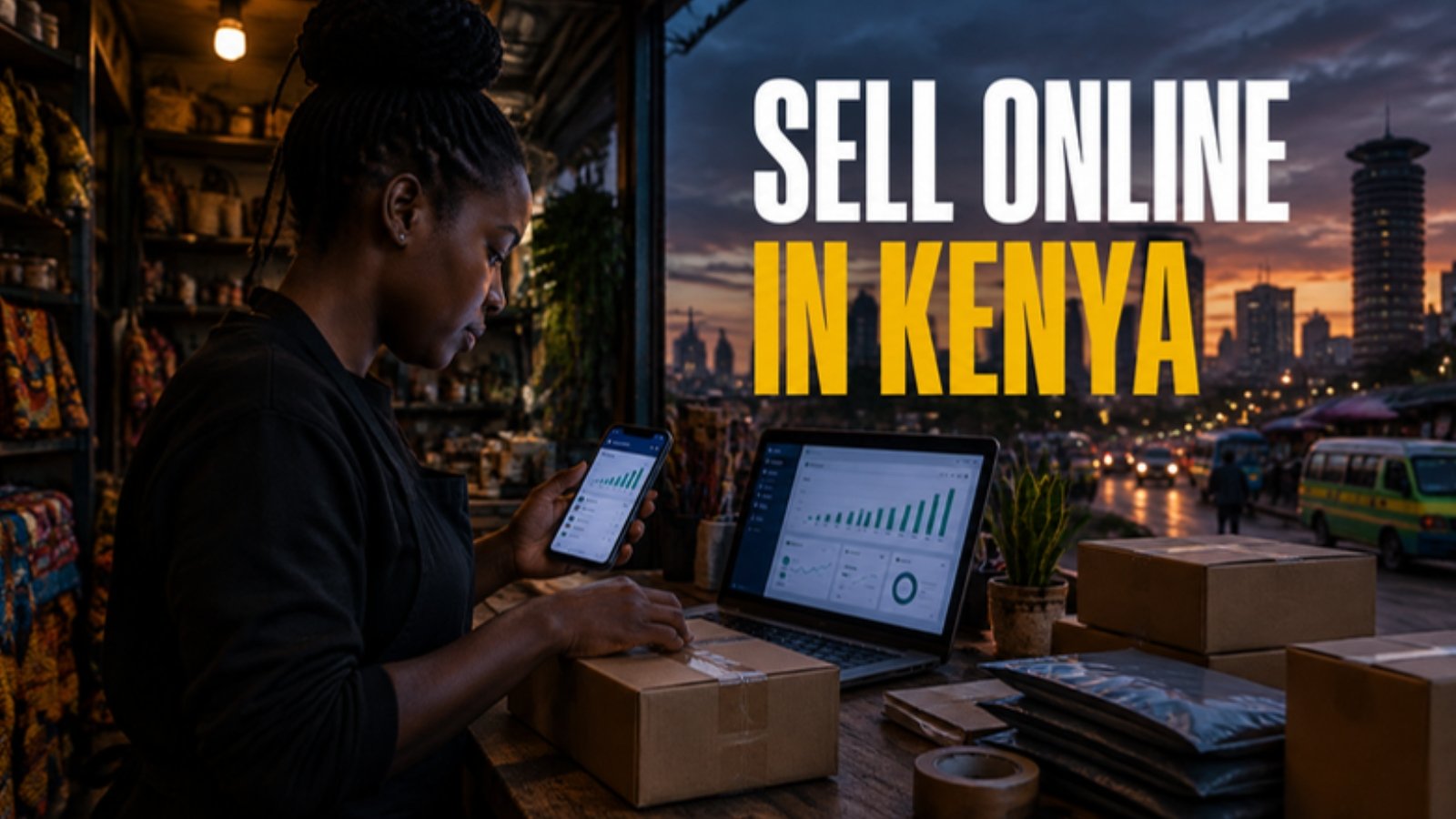
Kenyans already buy online every day. They order on WhatsApp, pay by M-Pesa, ask for delivery to an estate gate or a stage, and expect a confirmation message before the rider has left. The question isn’t whether your customers will shop online. It’s whether they’ll shop with you or with the business that made it easy. This is the complete guide to building an ecommerce website in Kenya: what one actually is, how it works from product page to doorstep, the features that matter, what drives the cost, the mistakes that sink most online shops, how to choose a developer, a realistic timeline and a 90-day launch plan.
The short version: an online shop isn’t a website with a “Buy” button stuck on it. It’s a sales system made of products, payments, delivery, stock, customer service and marketing. Get the system right and the website becomes your best salesperson. Get it wrong and it becomes an expensive brochure that nobody trusts with their money.
What an Ecommerce Website in Kenya Actually Is
An ecommerce website lets customers browse your products, add them to a cart, pay and arrange delivery or collection without needing to talk to anyone. In Kenya, a working online shop usually brings together five things:
- A catalogue: product pages with clear photos, prices in shillings, sizes or variants, stock status and honest descriptions.
- A checkout: a cart and payment flow that works on a phone, with M-Pesa as a first-class option, not an afterthought.
- Fulfilment: delivery zones, delivery fees, pickup points and a way to track each order from “paid” to “delivered”.
- Back office: order management, stock updates, customer records, receipts and reports you can actually use.
- Traffic: SEO, social media, ads and WhatsApp that bring the right people to the shop.
Most failed online shops in Kenya had a nice-looking front and nothing behind it. Orders arrived by email, stock was tracked in someone’s head, and payments had to be matched by hand against M-Pesa messages. That doesn’t scale past a busy weekend.
Do You Need Your Own Online Shop, or Is WhatsApp and Instagram Enough?
Plenty of Kenyan businesses sell well through Instagram DMs and WhatsApp catalogues. That’s a fine way to start. But there’s a ceiling, and you hit it fast:
- Every sale needs a person to reply, quote, confirm payment and arrange delivery.
- Customers who message at 11pm wait until morning, and many buy elsewhere.
- You can’t be found on Google when someone searches for exactly what you sell.
- You don’t own the platform. An account restriction or a change in reach can wipe out your sales channel overnight.
- You have no clean data on who buys what, how often, or from where.
Your own ecommerce website fixes all of that, and it doesn’t replace social media. The best setup uses social and WhatsApp to start conversations and the website to close the sale. We made the wider case for owning your digital assets in our piece on why your domain, hosting and reputation are business decisions; an online shop is the clearest example of why ownership matters.
How an Online Shop Works, Step by Step
It helps to walk through one order from start to finish, because every step is a place where you either win the sale or lose it.
1. The customer finds you
They arrive from a Google search, an Instagram post, a WhatsApp status, a Facebook ad or a friend’s link. The page they land on has to load quickly on a mid-range Android phone over mobile data, because that’s how most Kenyans will see it first.
2. They browse and decide
Good product pages answer questions before they’re asked: what’s included, sizes, colours, delivery time to their area, return policy and whether it’s in stock. Clear photos taken in good light beat clever design every time.
3. They add to cart and check out
The checkout asks for the minimum: name, phone number, delivery location and payment. Forcing customers to create an account before buying is one of the fastest ways to lose them.
4. They pay
For most Kenyan shoppers, that means M-Pesa. A proper integration sends an STK push to their phone, they enter their PIN, and the website confirms the payment automatically. Card payments and pay-on-delivery can sit alongside it.
5. The order reaches you
You get a notification, the order appears in your dashboard with payment already confirmed, and stock levels update on their own. No screenshots of M-Pesa messages, no guessing.
6. You fulfil and deliver
You pack the order, book a rider or courier, and the customer gets an SMS, WhatsApp or email update. For upcountry orders, that might mean a courier or parcel service; within Nairobi, a rider or a pickup point.
7. You follow up
A thank-you message, a request for a review and a reason to come back. Repeat customers are where an online shop makes its real money.
M-Pesa Payment Integration: The Feature That Makes or Breaks Kenyan Ecommerce
If your checkout doesn’t handle M-Pesa smoothly, you don’t really have a Kenyan online shop. There are a few common ways to take M-Pesa on a website:
- Manual Paybill or Till instructions: the customer pays separately and types in a transaction code. It’s simple but slow, error-prone and needs someone to check every payment by hand.
- Direct integration with Safaricom’s Daraja API: the website triggers an STK push to the customer’s phone and receives a confirmation when payment goes through. This is the smoothest experience and needs proper development and testing.
- A payment gateway or aggregator: a third-party service that handles M-Pesa, cards and sometimes other wallets in one place, usually for a transaction fee.
Whichever route you choose, test it properly: failed payments, timeouts, customers who close the browser mid-payment and refunds. These edge cases are where money goes missing. We’ll go deeper into the technical side of M-Pesa checkout in a dedicated guide; for now, insist that any developer you hire shows you a working M-Pesa checkout they’ve built before.
Features Every Ecommerce Website in Kenya Needs
Use this as your checklist before you sign off on any build.
Storefront
- Mobile-first design that loads fast on mobile data
- Clear categories and a search bar that actually finds products
- Product pages with multiple photos, variants, prices in KES and stock status
- Delivery information and estimated delivery times on the product page
- Reviews and ratings from real customers
- A visible WhatsApp button for questions
Checkout and payments
- Guest checkout, with an optional account
- M-Pesa STK push, plus card and pay-on-delivery if they suit your business
- Delivery zones and fees calculated automatically by area
- Order confirmation by SMS, WhatsApp or email
- Clear refund, return and exchange policies
Back office
- An order dashboard with statuses (paid, packed, dispatched, delivered)
- Stock management that updates on every sale
- Discount codes and simple promotions
- Customer records and order history
- Sales reports you can read without a data analyst
- Staff accounts with the right permissions
Trust and compliance
- An SSL certificate (the padlock) on every page
- Your physical address, phone number and business name clearly shown
- A privacy policy that reflects how you handle customer data under Kenya’s Data Protection Act
- Receipts and records that fit your tax obligations; if your business is required to issue eTIMS invoices, ask your accountant how online sales should be recorded and whether your shop needs to connect to your invoicing system
Growth
- SEO-friendly product and category pages
- Google Analytics and conversion tracking set up from day one
- Meta pixel and Google Ads tracking if you’ll run ads
- Abandoned cart reminders
- Email or WhatsApp opt-in for repeat customers
Choosing a Platform for Your Ecommerce Website
There’s no single right platform. The right one depends on how many products you have, how complex your operations are and how much control you need.
WordPress with WooCommerce
Flexible, widely supported and a good fit for most Kenyan SMEs. You own the site, there are well-established M-Pesa plugins and integrations, and it plays well with content and SEO. It needs reliable hosting and regular updates to stay secure and fast.
Hosted platforms (such as Shopify)
Quick to launch and easy to manage, with hosting and security handled for you. The trade-offs are monthly subscription fees, transaction fees on some plans, and M-Pesa often depending on a third-party app. Check how payments in shillings will actually work before you commit.
Custom-built ecommerce
Makes sense when you have unusual workflows: wholesale and retail pricing, multiple branches, integration with an ERP or POS system, a marketplace with several sellers, or a subscription model. It costs more and takes longer, but it fits the business exactly. If your shop needs to talk to stock, accounting or delivery systems, this is where custom software development comes in.
Whichever you choose, the fundamentals of good web design in Kenya still apply: speed, clarity, mobile-first layouts and a structure built around what customers are trying to do.
Hosting, Speed and Security for Online Shops
An ecommerce site works harder than a brochure site. It handles payments, logins, stock updates and traffic spikes on payday weekends and during promotions. Cheap shared hosting that’s fine for a five-page company site can buckle under that load.
What to look for:
- Hosting with enough resources for your product count and traffic, and room to grow
- Daily backups you can actually restore
- An SSL certificate and a firewall
- Fast support when something breaks during a sale
- Servers and caching that keep pages fast for visitors in Kenya
Our complete guide to web hosting in Kenya covers how to compare plans, what uptime and backups really mean, and when a growing business should move up from shared hosting.
Delivery and Logistics: The Part Most Shops Underestimate
In Kenya, delivery is part of the product. A customer who waits three days with no update won’t come back, however good the website looked. Before you launch, decide:
- Delivery zones: CBD, Nairobi estates, the wider metro area and upcountry, each with its own fee and timeline.
- Who delivers: your own riders, a delivery company, a courier for upcountry, or a mix.
- Pickup options: your shop, a partner pickup point or a parcel locker.
- Cut-off times: for example, orders before a set time go out the same day.
- Failed deliveries: what happens when nobody answers the phone at the gate.
- Returns: who pays, how quickly, and how the refund is sent back.
Build these rules into the website so delivery fees calculate automatically and customers know exactly what to expect before they pay.
What Drives the Cost of an Ecommerce Website in Kenya
Quotes for online shops in Kenya vary enormously, and the cheapest quote rarely ends up the cheapest. Instead of comparing headline prices, compare what’s actually included. The main cost drivers are:
- Number of products and categories: twenty products is a different job from two thousand, especially if someone has to upload them.
- Product photography and copy: professional photos and proper descriptions take time, but they sell.
- Payment integrations: M-Pesa STK push, cards and pay-on-delivery each add development and testing.
- Delivery logic: zone-based fees, courier integrations and tracking add complexity.
- Custom features: wholesale pricing, multi-branch stock, loyalty points, subscriptions or ERP and POS integration.
- Design: a customised template versus a fully bespoke design built around your brand.
- Platform and running costs: hosting, domain, premium plugins or apps, subscription fees and payment transaction fees.
- Training and support: who updates the site, fixes problems and keeps it secure after launch.
Ask every developer to separate the one-off build cost from the monthly and annual running costs. A shop that’s cheap to build but expensive to run, or impossible to update without calling the developer, isn’t cheap.
Your brand matters here too. Product pages, packaging and social ads all need to look like the same business. If you’re still working with a logo someone made in an afternoon, read our guide to logo design in Kenya before you build the shop around it.
Common Mistakes and Red Flags
Mistakes business owners make
- Launching with no photos worth looking at. Dark, blurry phone photos tell customers you’re not serious.
- Hiding the delivery fee until the last step. Surprise costs at checkout cause abandoned carts.
- Treating M-Pesa as an afterthought. If the payment flow is clumsy, people go back to WhatsApp or go elsewhere.
- No plan for traffic. A shop with no SEO, ads or social promotion gets no visitors.
- Nobody owns the shop day to day. Orders, stock and customer questions need a named person.
- Ignoring the mobile experience. Testing only on a laptop is testing the wrong thing.
Red flags in a developer
- They can’t show you a live online shop they’ve built with a working M-Pesa checkout.
- They register the domain or hosting in their own name.
- They won’t give you admin access to your own site.
- They promise “unlimited” everything for a suspiciously low price.
- There’s no mention of backups, security updates or support after launch.
- They don’t ask about your delivery process, stock or payments, only about colours and logos.
Many of these problems aren’t unique to online shops. We’ve covered the wider pattern in our breakdown of why most Kenyan business websites are losing customers.
How to Choose an Ecommerce Website Developer in Kenya
Use these questions in every conversation:
- Can you show me online shops you’ve built that are live and taking orders today?
- How will M-Pesa payments work, and how is each payment confirmed?
- Which platform do you recommend for my business, and why?
- Who will own the domain, hosting, website files and admin accounts?
- How will delivery fees and zones be handled?
- How do I add products, change prices and manage stock myself?
- What’s included in the build, and what are the monthly and yearly running costs?
- How are backups, security and updates handled after launch?
- What tracking and analytics will be in place on launch day?
- What support do you offer if something breaks during a promotion?
A good developer asks you just as many questions back: about your customers, margins, suppliers, delivery and how you handle orders today. That’s a sign they’re building a sales system, not just a website. You can see the kind of work we do on our portfolio and how we approach builds on our web design services page.
A Realistic Timeline for Building an Online Shop
Timelines depend on the size of the catalogue and the complexity of the features, but a typical SME ecommerce project moves through these stages:
- Discovery and planning: products, customers, payments, delivery rules, platform choice and the sitemap.
- Content gathering: product photos, descriptions, prices, policies and brand assets. This is where most projects stall, so start early.
- Design: homepage, category, product, cart and checkout layouts, designed for mobile first.
- Development: building the store, setting up payments, delivery logic, emails and the back office.
- Testing: real orders, real M-Pesa payments, failed payments, refunds and every device you can find.
- Launch and training: going live, plus training the people who’ll run the shop day to day.
A simple shop with a modest catalogue can move quickly. A custom build with integrations takes considerably longer. Be suspicious of anyone who promises a full ecommerce system in a couple of days without asking about your products.
Getting Traffic to Your Ecommerce Website
Launching a shop is the start, not the finish. Traffic comes from a mix of channels:
- SEO: optimised category and product pages that rank when people search for what you sell. Our guide to SEO services in Kenya explains what proper SEO work looks like.
- Google Shopping and search ads: putting products in front of people who are ready to buy.
- Social media: Instagram, TikTok and Facebook to show products in use and drive people to the shop.
- WhatsApp: broadcast lists and status updates for repeat customers, with links straight to products.
- Email and SMS: new arrivals, offers and abandoned-cart reminders.
If you’d rather hand this to a team, our guide to hiring a digital marketing agency in Kenya explains what to expect and how to hold an agency to results.
A 90-Day Plan to Launch and Grow Your Online Shop
Days 1 to 30: Build the foundation
- Decide your best-selling products to launch with; you don’t need the full catalogue on day one
- Get proper product photos and write clear descriptions
- Set delivery zones, fees, cut-off times and the returns policy
- Choose your platform and payment setup, including M-Pesa
- Register your domain in your business’s name and set up hosting
Days 31 to 60: Build, test and launch
- Build the store and load products
- Place real test orders using M-Pesa, card and pay-on-delivery
- Set up analytics, conversion tracking and order notifications
- Train the person who’ll manage orders and stock
- Launch to existing customers first and fix what they find
Days 61 to 90: Drive traffic and improve
- Promote the shop on social media and WhatsApp with direct product links
- Start a small, tracked ads campaign on your best products
- Ask every early customer for a review
- Review the numbers: which products sell, where customers drop off, which channels bring buyers
- Add products and features based on what customers actually do
Frequently Asked Questions
How much does an ecommerce website cost in Kenya?
It depends on the number of products, the platform, payment and delivery integrations, design and custom features. Ask for a written quote that separates the one-off build from ongoing costs such as hosting, domain, plugins, subscriptions and support, and compare what’s included rather than the headline figure.
Can my online shop accept M-Pesa automatically?
Yes. With a proper integration, customers get an STK push on their phone, enter their PIN, and the website confirms the payment and the order without anyone checking messages by hand. It can be done through Safaricom’s Daraja API or a payment gateway.
Is WooCommerce or Shopify better for a Kenyan business?
Neither is better for everyone. WooCommerce gives you more ownership, flexibility and well-established M-Pesa options; Shopify is quicker to set up with hosting handled for you but carries subscription fees and may rely on third-party apps for M-Pesa. Choose based on your catalogue, budget and how much control you need.
Do I still need social media if I have an online shop?
Yes. Social media and WhatsApp are where many Kenyan customers discover products. The shop is where you turn that attention into paid orders without someone replying to every message.
How long does it take to build an online shop?
A straightforward shop can be built fairly quickly once products, photos and policies are ready. Custom features, large catalogues and system integrations take longer. Gathering content is usually the biggest delay, so start there.
Build an Online Shop That Sells
An ecommerce website in Kenya succeeds when the whole system works: products people want, photos that sell, an M-Pesa checkout that just works, delivery customers can rely on, and marketing that brings the right people in. Build that system and your shop sells while you sleep. Skip it and you’ve paid for a very expensive catalogue.
Ready to build an online shop that takes orders, takes M-Pesa and takes your business further? Call or WhatsApp us on +254 717 806 693, email hello@twelvecitydigital.com, or book a consultation with Twelvecity Digital.
Disrupt. Build. Dominate.