Every week, a business owner somewhere in Nairobi pays someone for “SEO”. Three months later, nothing has changed. The phone isn’t ringing any more than before. The website still doesn’t show up when customers search. And the monthly report is a PDF full of charts nobody can explain.
That’s not because SEO doesn’t work in Kenya. It works extremely well. The problem is that “SEO services” has become a label anyone can stick on anything. This guide is our attempt to fix that. It explains, in plain language, what real SEO services in Kenya should include, how each part works, what it should cost you in time and effort, how to judge whoever you hire (including us), and what a sensible first 90 days looks like.
Bookmark it. Whether you do SEO yourself, hire a freelancer or work with an agency, this is the checklist to hold everyone to.
What SEO actually is, and why it matters for Kenyan businesses
Search Engine Optimisation is the work of making your website the answer Google picks when someone searches for what you sell. A logistics company in Mombasa wants to show up for “cargo clearing Mombasa”. A clinic in Kilimani wants to show up for “dentist near me”. A hardware supplier in Thika wants to show up for “roofing sheets prices Kenya”. A school in Kitengela wants parents searching “best primary schools Kitengela” to find it first.
Those searches are customers raising their hands. They already want what you sell, and they’re actively looking. That is the big difference between search and almost every other marketing channel. Social media interrupts people who were busy watching something else. Search catches people at the exact moment they need you.
And unlike adverts, you don’t pay for every visitor. Once a page ranks, it keeps bringing in traffic month after month. That’s why SEO is one of the best long-term investments a Kenyan business can make in its digital marketing, especially as more of the country’s buying journeys start on a phone with a Google search.
Good SEO has three core parts: technical, on-page and off-page/local. Content runs through all of them. A serious provider works on every part, because a weakness in one drags the others down.
Part 1: Technical SEO, the foundation
Before anything else, your website has to be fast, secure and easy for Google to crawl and understand. If the foundation is broken, no amount of content or link building will hold it up.
Why speed matters even more in Kenya
Most of your visitors are on mobile data, often on mid-range Android phones, and many are paying for every megabyte. A site that takes eight seconds to load on a patchy 4G connection loses people before they ever see your offer. Google knows this, and it uses page experience as part of how it ranks sites. Slow hosting, huge uncompressed images and bloated themes are the most common culprits we find on Kenyan business websites.
Your technical SEO checklist
- Mobile-first design. Google ranks the mobile version of your site. If buttons are tiny, text overflows or menus break on a phone, you’re losing rankings and customers.
- Page speed. Compress and resize images, use modern formats like WebP, enable caching, and remove plugins and scripts you don’t need.
- Reliable hosting. Cheap shared hosting that goes down or crawls at peak times hurts both rankings and trust. We go deeper on this in why your domain and hosting are your reputation.
- HTTPS everywhere. An SSL certificate (the padlock) is a must. Browsers flag sites without one as “Not secure”, which scares visitors off.
- Crawlability. An XML sitemap submitted to Google Search Console, a sensible robots.txt file, and no important pages accidentally hidden from Google.
- Clean structure. Logical URLs (yoursite.co.ke/services/tax-filing, not yoursite.co.ke/?p=1234), clear menus, and every important page reachable within a few clicks.
- Fix errors. Broken links, 404 pages, redirect chains and duplicate pages all waste Google’s attention and frustrate visitors.
- Structured data. Schema markup tells Google what your business is, where it’s located, your opening hours, reviews, FAQs and more. It can earn you richer results in search.
A good SEO provider starts with a technical audit, shows you the problems in plain language and either fixes them or works with your developer to fix them. If your website itself is the problem, which happens more often than people think, read why most websites in Kenya are losing their owners customers.
Part 2: Keyword research, finding what Kenyans actually search
Most SEO that fails, fails here. Business owners (and some providers) guess the words customers use, and the guess is usually wrong. You might call it “corporate apparel solutions”. Your customers search “branded t-shirts Nairobi”.
How proper keyword research works
- List your services and locations. Every product or service you want to sell, and every town or area you serve.
- Find the real search terms. Use keyword tools set to Kenya (not global or US data) to see what people actually type, how often, and how competitive each term is.
- Understand search intent. “What is VAT” is someone learning. “VAT consultant Nairobi” is someone ready to hire. Both are valuable, but they need different pages.
- Prioritise. Go after terms that have real searches, match what you sell, and are realistic to rank for. A new site won’t beat national giants on the hardest terms in month one, but it can win specific, local and long-tail searches quickly.
- Map keywords to pages. Each important keyword gets one dedicated page. Two pages targeting the same term compete with each other.
Local language matters too. Kenyans search in English, Swahili and a mix of both (“bei ya”, “near me”, “price in Kenya”). Good research picks up these patterns.
Part 3: On-page SEO, making every page the best answer
Once you know which search each page targets, on-page SEO makes sure the page deserves to rank for it.
Your on-page SEO checklist
- Title tags that include the keyword and give people a reason to click. This is the blue headline in Google.
- Meta descriptions that sell the click in about 150 characters.
- One clear H1 per page, with subheadings (H2, H3) that structure the content and answer related questions.
- Dedicated service pages. One page per service, not one “Services” page that lists everything in two lines each. “Website design”, “web hosting” and “SEO” each deserve their own page.
- Content that answers the question fully: prices or price factors, process, timelines, FAQs, proof (case studies, reviews) and a clear next step.
- Internal links from blogs and related pages to the pages that convert, using descriptive anchor text.
- Image optimisation. Descriptive file names and alt text, compressed sizes.
- Clear calls to action. Phone, WhatsApp, a short contact form. In Kenya, a WhatsApp button often converts better than anything else.
What on-page SEO is not: stuffing “best plumber Nairobi” twenty times into a page. Google stopped rewarding that years ago, and it can actively push you down.
Part 4: Local SEO, the fastest win for most Kenyan SMEs
When someone searches “accountant in Westlands”, “car hire Kisumu” or “hardware near me”, Google usually shows a map with three businesses before any normal website results. That’s the local pack, and for most small businesses it’s the most valuable real estate on the internet.
How to win the local pack
- Claim and verify your Google Business Profile. It’s free. Make sure you, not a former employee or a random agency, own it.
- Choose the right categories. Your primary category has a big influence on which searches you appear for.
- Complete every field: services, products, opening hours, service areas, description, attributes, website and WhatsApp.
- Keep your NAP consistent. Your business Name, Address and Phone should be identical on your website, Google, Facebook, directories and everywhere else.
- Get real reviews, steadily. Ask happy customers, make it easy with a direct review link, and reply to every review, good or bad.
- Post updates and photos regularly. Active profiles signal an active business.
- Build local citations. List your business on reputable Kenyan directories and industry listings.
- Create location pages if you genuinely serve several towns, each with real, specific content, not copy-pasted text with the town name swapped.
Local SEO can show results within weeks, which makes it the first thing we fix for most clients.
Part 5: Content, the engine that keeps SEO running
Every useful article you publish is another doorway into your website. A customer who searches “how to register a business in Kenya” and finds your genuinely helpful guide is far more likely to call you than one who has never heard of you.
What a good SEO content strategy looks like
- Pillar pages: long, complete guides on your core topics, like this one.
- Supporting articles that go deep on specific questions and link back to the pillar, so Google sees you as an authority on the whole topic.
- Questions your customers actually ask. Your sales and customer care teams hear them every day. Each one is a potential article.
- Kenyan context. Local prices, regulations, examples, places and payment methods like M-Pesa. Generic content copied from foreign sites rarely ranks or converts here.
- Consistency. A steady publishing schedule beats a burst of ten posts followed by a year of silence.
Content also feeds your social media, email newsletters and sales conversations. And it shapes how your brand is understood. We cover that side in brand strategy in Kenya’s crowded market.
Part 6: Off-page SEO and link building, earning trust
Google treats links from other reputable websites as votes of confidence. The more relevant and trustworthy the sites linking to you, the more Google trusts you.
Good link building in Kenya looks like
- Listings and member pages on industry associations and chambers of commerce
- Mentions in Kenyan news and business publications through genuine stories, data or expert comment
- Partner, supplier and client websites linking to you
- Guest articles on relevant, respected local sites
- Sponsorships, events and community work that earn coverage
Bad link building looks like
- Hundreds of links bought cheaply from unrelated foreign sites
- Link “packages” sold by the thousand
- Spammy blog comments and forum profiles
Shortcuts like these can trigger a Google penalty that takes months to undo. Ask any provider exactly where your links will come from.
Part 7: SEO in the age of AI search
Search is changing. Google now shows AI-generated overviews for many questions, and more people are asking tools like ChatGPT and Gemini for recommendations. This doesn’t make SEO obsolete. It raises the bar.
AI tools pull their answers from sources they trust: well-structured, factual, clearly written pages from businesses with a solid reputation online. The same things that make you rank in Google make you more likely to be cited by AI: expert content, clear structure, FAQs, consistent business information and real reviews. A good SEO partner should already be tracking how your brand appears in AI results, not just in the classic blue links.
SEO for different types of Kenyan businesses
SEO isn’t one-size-fits-all. The priorities change depending on what you do:
- Local service businesses (clinics, salons, garages, law firms): Google Business Profile, reviews and location pages first.
- Online shops: product and category pages, fast mobile checkout, product schema, and dealing with duplicate content from filters and variants.
- B2B companies (manufacturers, logistics, finance): detailed service pages, case studies and content that answers buyers’ long research questions.
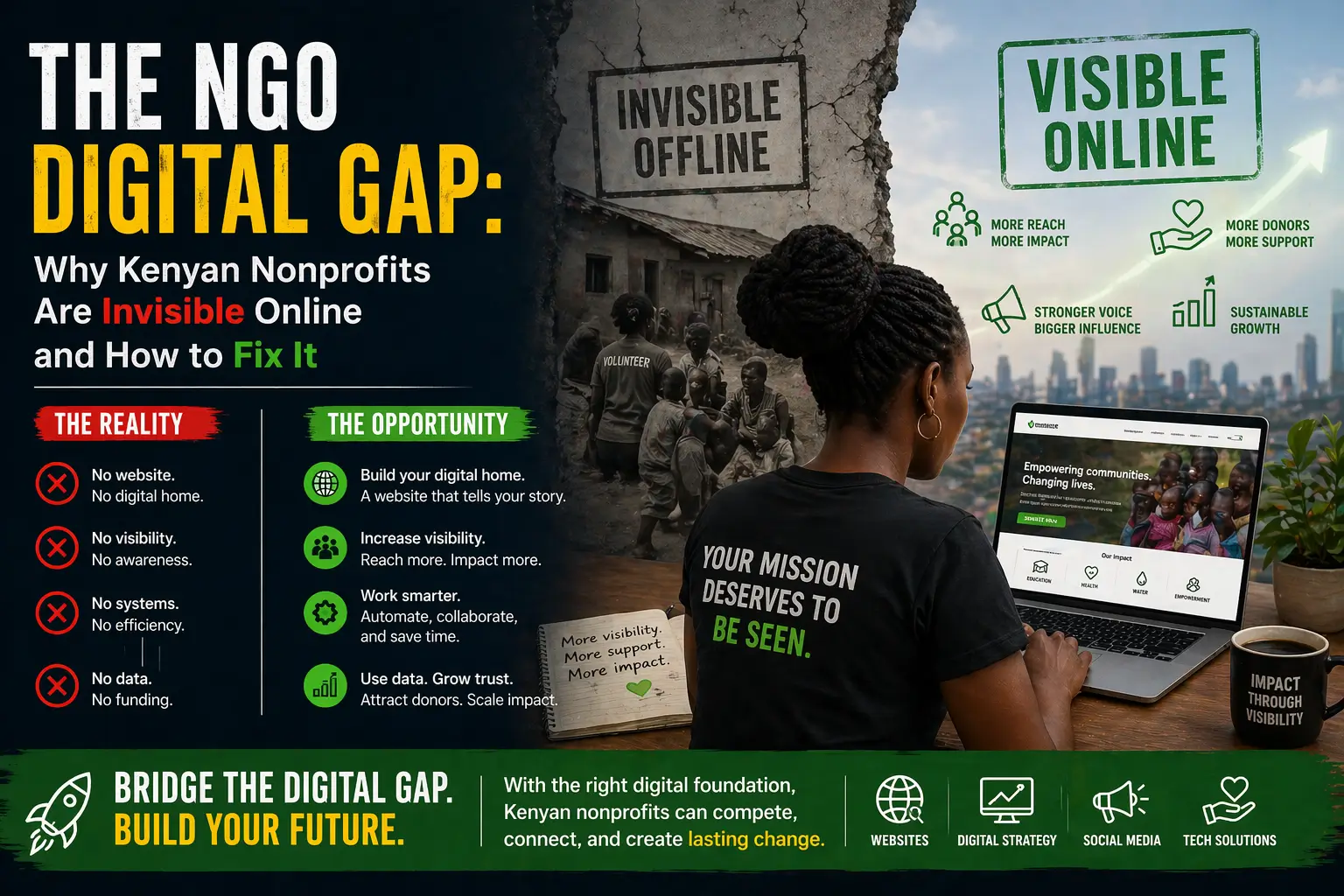
- NGOs and non-profits: visibility for donors, partners and beneficiaries, which we explore in why Kenyan nonprofits are invisible online.
- Schools and training institutions: local search, programme pages and content parents and students actually search for.
- SMEs competing with bigger brands: niche and long-tail keywords where you can win, which we discuss in why Kenyan SMEs are losing to bigger competitors.
Doing SEO in-house versus hiring SEO services
You can do a lot of SEO yourself, especially local SEO and content. Here’s an honest comparison:
- In-house works if you have someone with time, patience and willingness to learn, and a website that’s technically sound. The cost is mostly time.
- A freelancer can be good value for specific tasks like an audit, setting up your Google Business Profile or writing content. Check their past results carefully.
- An agency makes sense when you want technical work, content, local SEO, reporting and strategy handled together, with your website, hosting and marketing joined up.
Whichever route you choose, someone in your business should understand the basics in this guide, so you can tell good work from bad.
What affects the cost of SEO services in Kenya
Prices vary widely, and you should be suspicious of anything that sounds too cheap to be real. What drives the cost:
- The state of your website. A slow, broken site needs fixing before SEO can work.
- Competition. Ranking for “web hosting Kenya” takes far more work than ranking for a niche service in one town.
- Number of locations and services you want to rank for.
- Content volume. How many pages and articles are written each month.
- Link building and PR effort.
- Reporting and strategy time.
Treat SEO as an ongoing investment, not a one-off purchase. A one-time “SEO setup” can fix problems, but rankings are kept through steady work.
Red flags when hiring SEO services in Kenya
Walk away from any provider who:
- Guarantees the number one spot on Google. Nobody controls Google’s rankings.
- Won’t explain what they’re doing. You should understand the monthly work in plain English.
- Reports rankings for keywords nobody searches. Ranking first for a phrase with zero searches is worthless.
- Never asks about your business goals, margins or best customers.
- Promises results in two weeks.
- Wants access to everything but won’t give you ownership. Your website, Google Business Profile, Search Console and Analytics should always be in your name.
- Uses vague “secret techniques”. Real SEO isn’t secret. It’s disciplined work.
Questions to ask before you hire anyone
- What did you find when you looked at my website, and what would you fix first?
- Which keywords would you target, and why?
- Where will links come from?
- Who writes the content, and does it reflect my business and Kenyan customers?
- What will you report every month, and how does it tie to leads and sales?
- Can I see results you’ve achieved for a similar business?
- Will I own all accounts and content if we stop working together?
The results you should measure
Forget vanity charts. The numbers that matter are:
- Organic traffic from Kenya to your key service pages
- Rankings for keywords people actually search, with real search volume
- Calls, WhatsApp messages, form submissions and quote requests from search
- Google Business Profile views, calls, direction requests and website clicks
- Over time, revenue you can trace back to organic search
Set this up properly with Google Analytics 4, Google Search Console and call or WhatsApp tracking, so every report connects SEO to real enquiries.
How long does SEO take in Kenya?
Honest answer: it depends on your starting point and competition. For most businesses:
- Weeks 1 to 6: technical fixes and local SEO start to show early movement.
- Months 2 to 4: optimised pages and new content begin ranking for specific and local searches.
- Months 4 to 12: authority builds, competitive terms move, and enquiries from search become steady.
The upside is that unlike ads, the traffic doesn’t disappear the day you stop paying.
A practical first 90 days of SEO
Days 1 to 30: fix and set up
- Full technical audit and the most important fixes (speed, mobile, errors, SSL)
- Google Search Console, Analytics 4 and conversion tracking
- Keyword research and a keyword-to-page map
- Google Business Profile claimed, verified and fully completed
Days 31 to 60: optimise and publish
- Rewrite titles, descriptions and content on key service pages
- Create missing service and location pages
- Publish the first pillar guide and supporting articles
- Start a steady review-request routine
Days 61 to 90: build authority and review
- Directory listings, citations and the first quality links
- Internal linking between blogs and service pages
- First full report: what moved, what didn’t, and the plan for the next quarter
Frequently asked questions
Is SEO better than Google Ads?
They do different jobs. Ads bring traffic immediately but stop when you stop paying. SEO takes longer but keeps working. Many businesses use ads for quick wins while SEO builds.
Does social media help SEO?
Not directly as a ranking factor, but it helps people discover your content, which can lead to links, searches for your brand and reviews.
Do I need a blog for SEO?
If you want to rank for questions your customers ask, yes. Service pages capture people ready to buy; articles capture people earlier in their journey.
Is a .co.ke domain better for SEO in Kenya?
It signals to Google and to customers that you’re a Kenyan business, which helps with local trust. It’s not a magic ranking boost on its own, but it’s the sensible choice for businesses focused on Kenya.
SEO done properly, by a team that explains it
At Twelvecity Digital, our Marketing & SEO Services cover the full picture: technical SEO, keyword research, on-page optimisation, local SEO, content, link building and clear monthly reporting tied to leads, not vanity numbers. Because we also design websites and provide hosting and domains, we fix the foundation instead of working around it. You can see some of that work in our portfolio.
Want to know where your website stands today? Talk to us for an SEO review. Call +254 717 806 693, email hello@twelvecitydigital.com, or reach us through our contact page.
Disrupt. Build. Dominate.