Most Kenyan businesses don’t have a website problem. They have a “we built a website once and forgot about it” problem. The site went live, someone shared the link on WhatsApp, and then it sat there: slow on a phone, impossible to update, and invisible on Google. This is the complete guide to web design in Kenya for business owners who want a website that actually brings in enquiries. It covers what a proper website includes, how the project works step by step, what drives the cost, the red flags to walk away from, and a practical plan you can start this month.
If you only read one thing, read this: a website is not a brochure you print once. It is a sales tool, a trust signal and the place every other piece of your marketing points to. Build it like one.
Web Design in Kenya: What It Actually Means in 2026
“Web design” gets used to mean anything from a free template to a custom platform that runs half a business. For a Kenyan SME, NGO or corporate, good web design covers five jobs at once:
- Clarity: a visitor understands what you do, who you serve and where you are within a few seconds.
- Trust: real photos, real contacts, a physical address, clear pricing or a clear way to get a quote, and proof of past work.
- Action: every page leads somewhere, whether that is a WhatsApp chat, a call, a quote form, a booking or a checkout.
- Findability: the site is built so Google can read it, index it and rank it for the searches your customers actually type.
- Control: your team can update prices, add products, publish news and change photos without calling a developer every time.
Most of the Kenyan websites that fail do so on the last three. They look fine in a meeting room on a big screen, then fall apart on a mid-range Android phone on mobile data, which is how a large share of your customers will see them. We unpacked the most common failures in why most Kenyan business websites are losing you customers; this guide is the fix.
The Types of Websites Kenyan Businesses Need
Before you talk to any designer, know which kind of site you need. The scope, price and timeline change completely between them.
1. Business or SME website
Five to fifteen pages: home, about, services, a page for each main service, portfolio or projects, blog and contact. This is the right starting point for most professional firms, contractors, clinics, schools, consultants and service businesses. The goal is enquiries.
2. Corporate website
Larger structure, several departments or subsidiaries, investor or governance pages, careers, tenders, downloadable reports and often more than one language. Corporates usually need tighter brand control, user roles and approval workflows in the content system.
3. E-commerce website
A product catalogue, cart, checkout, M-Pesa and card payments, delivery zones and order management. WooCommerce and Shopify are the common platforms. The hard part is not the design; it’s stock, delivery and payment reconciliation.
4. NGO and non-profit website
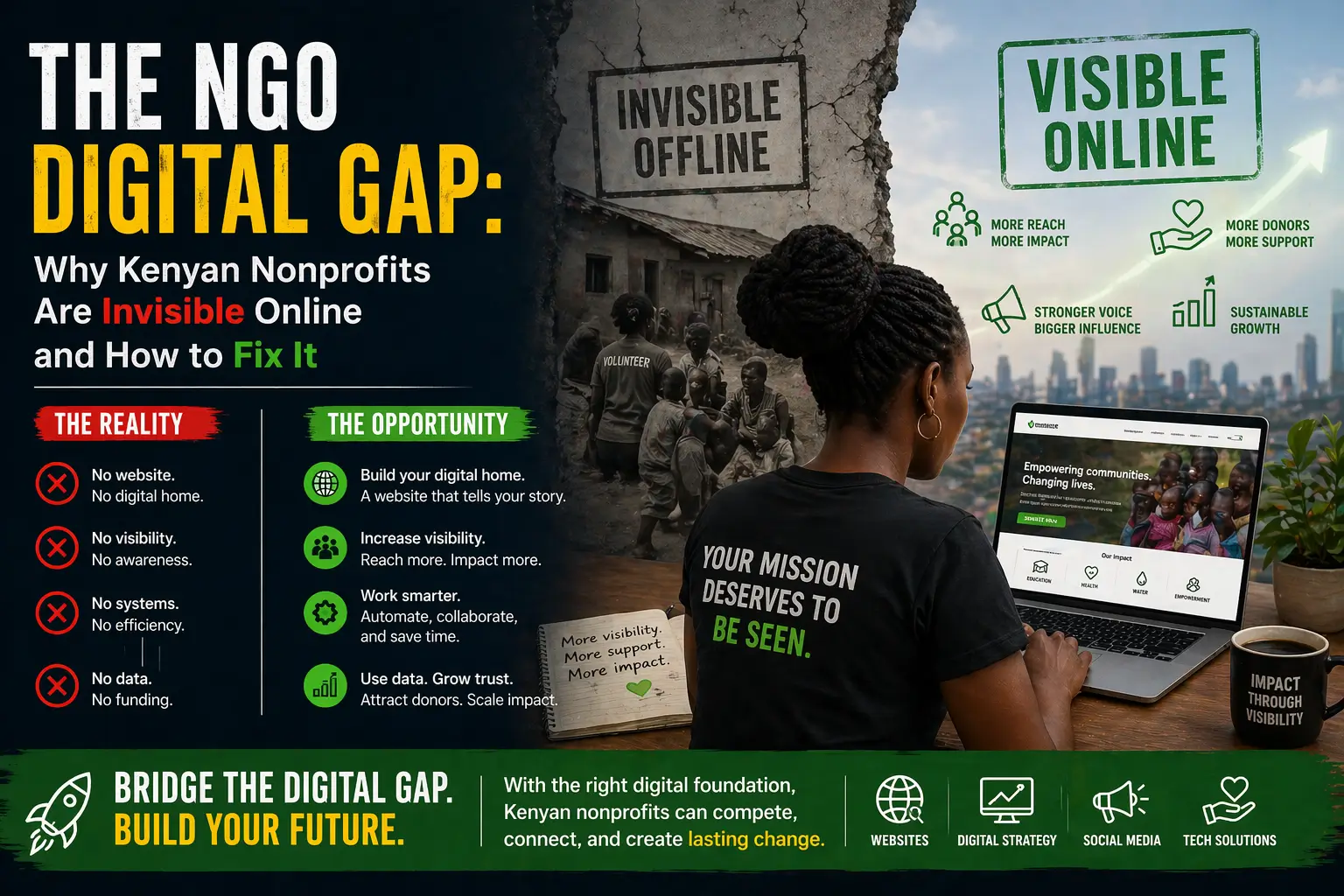
Programme pages, impact stories, donor and partner sections, reports, and sometimes online giving. Funders check your website before they check your proposal. We covered this gap in why Kenyan nonprofits are invisible online.
5. Landing pages
Single-purpose pages built for one campaign, one offer or one ad set. They convert better than sending paid traffic to your home page because they remove every distraction.
6. Web portals and custom platforms
Client logins, booking systems, school portals, internal dashboards, or integrations with your POS, ERP or CRM. At this point you are into software development, not just web design. If that’s where your business is heading, read how custom software helps Kenyan SMEs compete with bigger players and look at our software development solutions.
How a Web Design Project Works, Step by Step
A professional website project in Kenya follows roughly the same path, whoever builds it. If a designer skips straight to “send me your logo and we’ll start”, most of these steps are being skipped too.
Step 1: Discovery
The designer should ask what the site must achieve: more calls, more quote requests, more online sales, more donors, fewer repetitive questions to your front desk. They should ask who your customers are, which towns you serve, who your competitors are, and what is not working on your current site. A good discovery session ends with written goals.
Step 2: Sitemap and content plan
Next comes the list of pages and what goes on each one. This is where SEO starts, because every service you want to rank for needs its own page with its own focus keyword. A single “Services” page listing eight things will rank for none of them. Our guide to SEO services in Kenya explains why page structure matters so much.
Step 3: Wireframes and user experience
Wireframes are simple layouts that show where everything goes before any colour is added. They answer practical questions. Where does the WhatsApp button sit on mobile? What does someone see before they scroll? How many taps does it take to request a quote? Design the experience first, then the interface.
Step 4: Visual design
Now the brand comes in: colours, typography, photography and icons. If your brand itself is weak or inconsistent, fix that first or alongside the website, because a website will magnify whatever brand you give it. Our piece on brand strategy in Kenya’s crowded market explains why.
Step 5: Development
The approved design gets built. For most businesses that means WordPress, built cleanly rather than stacked with heavy page builders and twenty plugins. For shops it may be WooCommerce or Shopify. For portals it may be a custom application. Development should happen on a staging site you can preview, not on your live domain.
Step 6: Content loading
Text, images, team photos, product data, downloads. This is where most Kenyan web projects stall, because the client was supposed to “send the content” and never did. Agree early who writes what and by when. If you don’t have time to write, budget for copywriting.
Step 7: On-page SEO and tracking
Every page gets a title tag, meta description, clean URL, headings, image alt text and internal links. Google Analytics 4 and Google Search Console get connected. Your Google Business Profile gets linked. If this step is missing, you’re launching a site nobody will find.
Step 8: Testing
Test on real phones, not just a laptop. Test forms, WhatsApp links, phone links, payment flows and page speed on mobile data. Check every page for typos and broken links.
Step 9: Launch
The site goes live on your domain with SSL (the padlock). Old URLs get redirected to new ones so you don’t lose any ranking you already had. The sitemap gets submitted to Google.
Step 10: Handover and training
You should receive admin access, a short training session or video on how to update the site, and a document listing your domain, hosting, email and plugin licences, all in your company’s name.
The Non-Negotiables: A Website Checklist for Kenyan Businesses
Use this checklist on your current site, or on any proposal you receive.
- Mobile-first layout: designed for a phone screen first, then scaled up.
- Fast loading: compressed images, good caching, light code and decent hosting. Test with Google PageSpeed Insights on mobile.
- SSL certificate: the padlock in the address bar. Browsers warn visitors away from sites without it.
- Click-to-call and WhatsApp: one tap to reach you, visible on every page on mobile.
- M-Pesa where relevant: if you sell online, customers expect to pay with M-Pesa as well as cards.
- Clear contacts and location: physical address, map, phone and email that match your Google Business Profile exactly.
- A page per service: each with its own heading, keyword and call to action.
- Proof: portfolio, case studies, client logos (with permission), certifications and real team photos.
- Analytics and Search Console: so you know where visitors come from and what they search.
- Backups and security: automatic backups stored off the server, updated plugins and a firewall.
- Editable content: you can change text and images without touching code.
- Ownership: your domain, hosting account and admin logins are registered to your business, not the designer.
- Accessibility basics: readable font sizes, enough colour contrast, alt text on images and forms that work with a keyboard.
The ownership point catches more Kenyan businesses than any other. When the relationship with a freelancer ends and the domain is in their name, your email, website and reputation go with them. We wrote a whole piece on why you must own your domain, your hosting and your reputation.
Website Design in Kenya: Prices and What Drives the Cost
“How much is a website?” is the first question everyone asks, and the honest answer is that it depends on a handful of factors you can control. Two quotes for “a website” can differ hugely because they describe completely different products. Instead of comparing totals, compare what each quote includes.
The main cost factors
- Number of unique page designs: ten pages using two templates cost far less than ten individually designed pages.
- Functionality: forms and WhatsApp buttons are simple; e-commerce, bookings, member logins, multi-language content and system integrations add significant work.
- Custom design versus template: a customised theme is faster and cheaper; a fully custom design costs more but fits your brand and conversion goals precisely.
- Content: who writes the copy, who takes the photos, and how many products need loading.
- SEO setup: basic on-page settings versus proper keyword research and page planning.
- Integrations: M-Pesa, payment gateways, CRM, ERP, POS or third-party APIs.
- Revisions and timeline: rushed timelines and unlimited revisions both cost money.
The running costs nobody mentions
The build is a one-off. These come every year, and a fair quote should list them:
- Domain renewal (.co.ke or .com)
- Hosting, sized for your traffic and properly backed up
- Business email
- Premium plugin or theme licences
- Maintenance: updates, security monitoring and fixes
- Ongoing SEO and content if you want to keep growing traffic
Our hosting and domain services cover the infrastructure side, so the site, the domain and the email sit in one place, in your name.
How to compare quotes fairly
Ask each provider for a line-item quote showing pages, features, content responsibilities, SEO work, hosting, maintenance and the number of revision rounds. Then compare like with like. The cheapest quote often leaves out the very things that make a website produce enquiries.
Common Web Design Mistakes and Red Flags
These are the patterns we see again and again when Kenyan businesses come to us after a website that didn’t work.
Mistakes business owners make
- Designing for the boardroom, not the phone. Approving a design on a laptop and never checking it on an ordinary Android handset.
- One “Services” page for everything. It is impossible to rank one page for eight different services.
- No call to action. Beautiful pages that never ask the visitor to call, chat or request a quote.
- Stock photos of people who clearly aren’t Kenyan. Visitors notice, and trust drops.
- Launching and leaving. No updates, no new content and no one checking whether the contact form still works.
- Delaying content. A project that should take weeks drags on for months because the copy never arrives.
Red flags in a web designer
- They register the domain or hosting in their own name.
- They won’t show live websites they’ve built, only screenshots.
- The quote is a single number with no breakdown.
- They promise “page one of Google” by a date. Nobody controls Google’s rankings.
- There’s no written scope, timeline or revision limit.
- They never ask about your goals, customers or competitors.
- They can’t explain what happens after launch: who updates plugins, who backs up the site, who fixes it when it breaks.
- Their own website is slow, broken on mobile or out of date.
How to Choose a Web Design Company in Kenya
Whether you’re looking for website designers in Nairobi, Mombasa, Kisumu or anywhere else, these questions separate serious providers from the rest.
- Can I see three live websites you built, and speak to one of those clients? Open them on your phone during the meeting.
- Who will own the domain, hosting and admin access? The only acceptable answer is “you”.
- What is your process, step by step? Listen for discovery, sitemap, wireframes, testing and training.
- What SEO is included at launch? Titles, meta descriptions, page structure, redirects, Search Console and analytics at a minimum.
- Which platform will you use, and why? The answer should fit your needs and your team’s skills, not just the designer’s habit.
- How fast will the site load on mobile? Ask them to show PageSpeed results for a site they’ve built.
- Who writes the content? Get it in writing.
- What happens after launch? Maintenance, support response times and the cost of changes.
- Can you integrate M-Pesa, WhatsApp, our CRM or POS? If you need it, check they have done it before.
- How do you measure success? A good answer talks about enquiries, sales and rankings, not just “a beautiful site”.
You can see the kind of work we deliver for Kenyan businesses, NGOs and institutions in our portfolio of websites and digital projects.
A Realistic Website Timeline
Timelines depend mainly on scope and on how quickly content and feedback come back. As a rough guide to the phases:
- Discovery and sitemap: the first week or so.
- Wireframes and design: one to two rounds of feedback on the key page designs.
- Development and content loading: the longest phase, and the one most affected by late content.
- Testing and fixes: never skip it, however close the deadline.
- Launch and training: a day or two, plus a check-in after the first weeks live.
A simple business website with content ready moves quickly. An e-commerce store or portal with integrations takes considerably longer. The single biggest delay in almost every project is content, so start writing before the designer starts designing.
After Launch: Maintenance, SEO and Growth
Launch day is the start, not the finish. A website that isn’t maintained slowly gets slower, less secure and less visible.
Monthly maintenance
- Update WordPress, the theme and plugins.
- Check backups exist and can actually be restored.
- Test forms, WhatsApp links and checkout.
- Check uptime and page speed.
- Fix broken links and outdated information such as prices, staff and phone numbers.
Ongoing visibility
- Publish useful content that answers your customers’ questions.
- Keep your Google Business Profile updated with posts, photos and replies to reviews.
- Watch Search Console for queries where you’re close to page one, and improve those pages.
- Run campaigns to dedicated landing pages, not the home page.
Our marketing and SEO services pick up exactly where the build stops. For the wider picture of which channels are working for Kenyan businesses right now, see the state of digital marketing in Kenya.
A Practical 30-Day Plan for Your Website
Whether you’re starting from nothing or fixing an old site, this plan gets you moving.
Week 1: Audit and goals
- Open your current site on your own phone and your customers’ kind of phone. Write down everything that’s slow, broken or confusing.
- Confirm who owns your domain and hosting. Get the logins.
- Write down the one action you want visitors to take, and the three services that make you the most money.
Week 2: Structure and content
- List the pages you need: one per main service, plus about, portfolio, contact and blog.
- Draft the text for each page in plain language: what it is, who it’s for, why you, what to do next.
- Gather real photos of your team, premises and work.
Week 3: Choose a partner
- Shortlist two or three providers and ask them the ten questions above.
- Request line-item quotes and compare like with like.
- Agree a written scope, timeline and ownership terms.
Week 4: Build and measure
- Approve wireframes and the home page design.
- Set up Google Analytics, Search Console and your Google Business Profile if they aren’t already in place.
- Agree the maintenance plan before launch, not after the first problem.
Frequently Asked Questions About Web Design in Kenya
How much does website design cost in Kenya?
It depends on the number of pages, the features, who provides the content, and whether you need e-commerce or integrations. Ask for a line-item quote and check that domain, hosting, email and maintenance are listed, because those are recurring costs that cheaper quotes often leave out.
Is WordPress good for Kenyan business websites?
For most business, NGO and content-led websites, yes. It’s flexible, easy to update and widely supported. The quality depends on how it’s built: a clean theme with few, well-chosen plugins performs far better than a site stacked with page builders and add-ons.
How long does it take to build a website?
A small business site with content ready can be done in a few weeks. E-commerce stores, portals and sites with integrations take longer. Late content and slow feedback are the most common causes of delay.
Do I need SEO if I have a new website?
Yes. A new website with no SEO is like opening a shop down an unmarked alley. Basic on-page SEO should be part of the build, and ongoing SEO is what grows your visibility after launch.
Can I add M-Pesa payments to my website?
Yes. M-Pesa can be integrated into WooCommerce and custom sites, alongside card payments. Plan it at the start of the project, because it affects checkout design, testing and reconciliation.
Build It Right the First Time
A good website in Kenya is clear, fast on a phone, easy to find on Google, simple for your team to update and fully owned by your business. Everything else is decoration. Use the checklist, ask the hard questions and treat your site as the hardest-working salesperson you have.
If you want a website that’s built for enquiries, not just for applause, talk to us about professional web design in Kenya. We design and build business, corporate, NGO and e-commerce websites, then keep them fast, secure and visible.
Talk to Twelvecity Digital:
📞 +254 717 806 693 / +254 718 389168
📧 hello@twelvecitydigital.com
📍 Park Plaza Office Suites, S3 Off Eastern Bypass, Kenya
Or send us a message through our contact page for a free website quote.
Disrupt. Build. Dominate.